Opening a Door from ‘Bonnie Vale’ Moyarra
Compiled by Dennis Conn
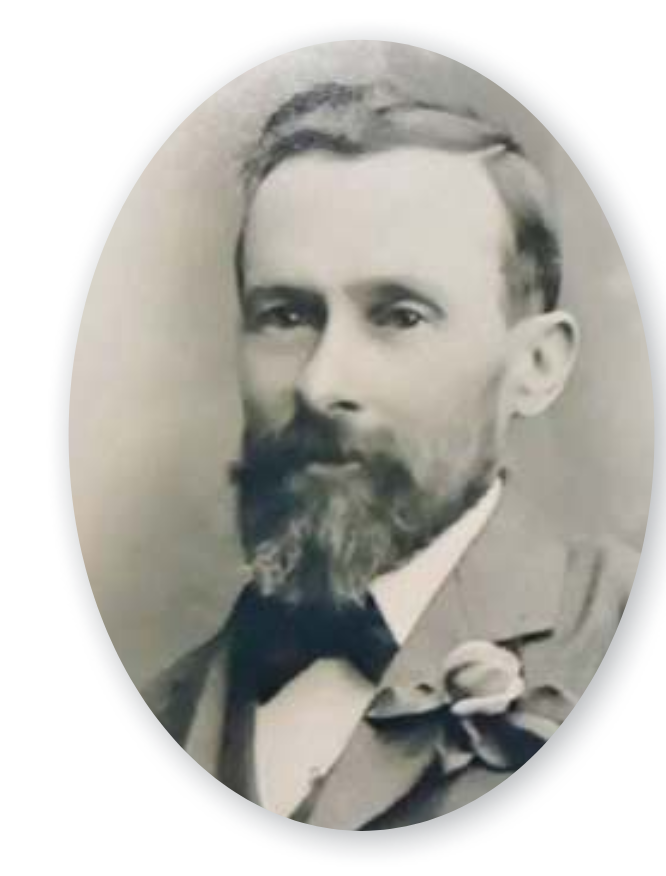
George Matheson in 1852. Photograph courtesy Lynden Matheson
The following narrative is founded in, and stems from experiences and memories, all of which were passed down to me from both my maternal grandmother, Jane Clark nee Matheson and my mother, Dorothy Ricardo nee Clark. The following memories and accounts of events by and large, are not to be found in the pages of The Land of the Lyre Bird however, they may at times make reference to some events mentioned in that book. It is more about the people who came and developed Bonnie Vale. Other than in the writings of the Land of the Lyre Bird, very little of their toil, achievements, contributions to the development of the dairy farming industry, local social history or changing landscape has been recorded. Most of this verbal history is now at risk of fading into the mists of time.
The following has been compiled by Dennis, primarily from a verbal history of Bonnie Vale and its people, passed down to myself and siblings and now passed on to my husband and children. There are a number of items I now hold that add some measure of veracity to this narrative, such as the two paintings my great grandfather George Matheson had commissioned. His original oil paintings of both the Log Cabin, built by himself and the Bonnie Vale homestead with a view to the coastline. His personal first edition copy of The Land of the Lyre Bird, inscribed with his own hand written pen and ink signature and the words “Bonnie Vale May 1921”, that same book is stamped with the Bonnie Vale insignia, consisting of the two letters B & V intertwined, and his original writing desk which he may have used in recording his recollections and experiences. — Val Conn nee Ricardo. 1 February 2024
Stored away at Whitelaw there is a large, heavy and ornate old door, still attached to its side panels, over mantel and wide doorstep. It is the original doorway entrance from the homestead at Bonnie Vale Moyarra. The door was purchased from the Berryman Family in the 1990’s when they, the then owners of Bonnie Vale, demolished the old homestead in favour of a new brick home but kept the old door that was still in good order and was stored in an out building.
Today only a mere remnant of the 320-acre property selected by George Matheson in 1883 on the Korumburra – Wonthaggi Road at number 1095 remains, that being a replica of the original gateway entrance to Bonnie Vale. Now situated on the south–east side of the main road just south of Hairs Rd, the replica gateway entrance to what is now a small acreage property. Bonnie Vale was so named in recognition of the Matheson’s Scottish ancestry and still commands broad sweeping views southward over the Outtrim and distant plains to Inverloch and Bass Strait.
George Matheson came from Clarendon near to Ballarat leaving his wife and first child, a baby son named John, with his parents John and Ann Matheson on their farm while he traveled to South Gippsland in a quest to find a property of his own. George was then thirty one years of age; his parents John and Ann had emigrated from the town of Dornoch in Scotland to Victoria in 1850. My great grandmother Catherine Matheson nee Leng had grown up on her parent’s citrus orchards at Irymple, where her family home still remains. The Lengs later gained some notoriety as the cultivators of the Leng Navel Orange.
After selecting his property, George Matheson cleared enough of the great forest on Bonnie Vale to establish some open pasture, sufficient to run a few Ayrshire dairy cows, fenced several paddocks and built a log cabin and a cow shed. His wife Catherine with their baby son, then came over from Clarendon by rail and then by horse from Drouin to Moyarra. While living in the Log Cabin, as seen on page 268 in the Land of the Lyre Bird, the property was cleared of many of the trees and scrub forming the great forest that was covering the land, leaving only a few patches of undergrowth and tree stumps.
While George Matheson sought work off the property in order to make ends meet, he also continued to establish pasture on his own property. His wife milked the cows and made butter for sale as well as providing care for her growing family of children. Catherine would take her children along with her to the edge of the undergrowth or fence line, then placed her children in a hollow log while she gathered up the dairy cows, returned to the children, then drove the small herd back to a small milking shed, then milked them by hand. Catherine bore a total of eleven children between 1883 and 1901, five boys and six girls; after six years of living in the log cabin they were able to move into their new homestead. As their family grew so too did the rooms of the homestead in order to accommodate them.
The remaining stumps of the giant eucalypt trees dotted the pastured landscape and the only way to remove them was to burn them after they had dried out. As long as the soil was dry enough, a fire lit in the centre of a stump would fan out through the root systems burning underground, all the while turning the wood into glowing red-hot ash. My grandmother Jane, as she grew older, had the job of bringing in the cows to be milked. In so doing on one occasion, while walking over pasture she accidently stepped upon an area that had a burning tree root system beneath it and her legs dropped into a hole of burning embers. All her mother could do was to cover her burns with butter, a then common remedy for burns. Gran carried the obvious scars that covered her legs for the rest of her life.
Catherine Matheson passed away suddenly four years after the birth of her last child in 1907 at the age of 46; she was laid to her somewhat premature but hard earned rest in the Outtrim Cemetery, only a short distance from her home. Some years later two of her daughters were also interred there: Georgina, a spinster, and Violetta, who had married Alfred Barnes. George had his wife and daughter’s graves fully covered; there are very few such graves in the Outtrim cemetery. Many years later two of the Matheson’s grandchildren were interred beside them; they were, first an infant and then a teenager who drowned as the result of a boating accident at Inverloch.
George Matheson was a man considered by many to have been a man before his time. He had through his initiative built up a highly productive dairy farm and a butter and cheese making business operated primarily by his own wife at first, then with the aid of family. He donated land upon which was built the Moyarra Presbyterian Church, opened in 1893 and destroyed by the bush fires of 1898. After the fire the church services were held in the log school house. My grandmother’s bible presented to her as a token of remembrance from her Sunday School Class on her wedding day on the 6th of May 1914 still exists.
George Matheson made sure his children were well provided for while in his care; Bonnie Vale remained a financially viable enterprise, as he was quick to embrace new and innovative methods of dairy farming and land management. Unfortunately, there was an enormous setback when in 1912, their dairy factory with its butter and cheese making plants, refrigeration plant along with its contents were destroyed by a fire. No one was home when the fire broke out as the family had traveled down to Kongwak to attend a social event. The cause of the fire was never found and was thought to have been highly suspicious. One could only speculate as to the fire’s cause, or why it may well have been arson. George Matheson did not allow the two greatest losses of his life on Bonnie Vale to overcome him, that of his wife, or their butter and cheese making plants. He and his family continued to strive toward improvements within the Dairy Farming Industry and their own local environment.
The age of mechanism had dawned and George Matheson invested heavily in the best available farm machinery and built silos for the storage of cattle fodder. He was the first in the district to have a motor car, a chain driven Galloway, imported from America and assembled by himself. Then later he upgraded to cars that were of a more modern vintage of the time, one of which had a shaft from the motor that could drive a belt driven circular saw bench, used for the sawing of fire wood.
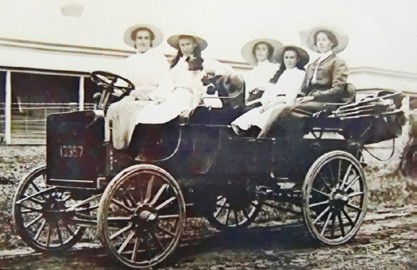
Galloway ‘ motor car with five of the Matheson girls in front of Bonnie Vale homestead circa 1912. Photograph courtesy Lynden Matheson.
Three of the Matheson sisters married three of the Clark brothers from Whitelaw, sons of Henry and Elizabeth Clark. Elizabeth Clark gave birth to six sons and six daughters and with her last pregnancy gave birth to twins, a boy and a girl, making her family seven of each. The Matheson and Clark families shared mutual interests through their Scottish heritage and their Presbyterian religion. There were other business and more personal interactions with surrounding pioneer families. The Holmes Family of Arawata purchased George Matheson’s first car, the Galloway, then later used a part of its mechanism to drive a water pump. His youngest child and son, also named George, married into the Adkins Family of Arawata; he married Miss Grace Adkins.
My Grandmother Jane was the first of the three sisters to marry one of the Clark brothers, and did so to Charles Henry Clark at her Bonnie Vale home in 1914. Followed by her sisters: Harriet, known as Hett, to Walter James (Jim) Clark also at Bonnie Vale in 1922; then Kate to Robert Clarence (Bob) Clark in 1926. My grandmother while growing up learnt from her father the art of making accurate predictions as to coming weather conditions, by the study of both sunrises and sunsets in conjunction with the phases of the moon. This was a valuable asset during her early married life when she and my grandfather lived on the lower end of Bena Road, Korumburra, where they conducted a market gardening business.
Bonnie Vale had become the social centre of the Moyarra district and the Matheson Family hosted a large number of social events, catered for by the daughters of the family. In particular the pioneer gatherings, inviting not only pioneers from the Moyarra district, but also pioneers from other areas of South Gippsland. George Matheson and his contemporaries had the foresight and desire to leave for future generations a record of their settlement within the great forests of South Gippsland. From their South Gippsland Pioneers Association they formed at first a committee of nine people from Moyarra with George Matheson as the chairman, then followed a series of meetings held at Bonnie Vale.
After a number of successful gatherings of pioneers, some from distant areas, it became necessary to extend the radius of scope of territory to be represented. Consequently, people from various districts were asked to assist, with the result that 15 members were elected as a new committee. The members were: G. Matheson, Chairman and Treasurer, Moyarra; J.W. Williams, Kongwak; R.N. Scott, Kongwak; R.J. Fuller, Bena; A. Gillam, Poowong; W.H.C. Holmes, Arawata; W. Mc Harg, Korumburra; A. Mc Lean, Moyarra; M. Halford, Korumburra; J. Western, Kardella; H. Dowel, Moyarra; T.J. Coverdale, Bena; W.M. Rainbow, Moyarra; A.W. Elms, Moyarra; F.P. Elms, Moyarra; Secretary.
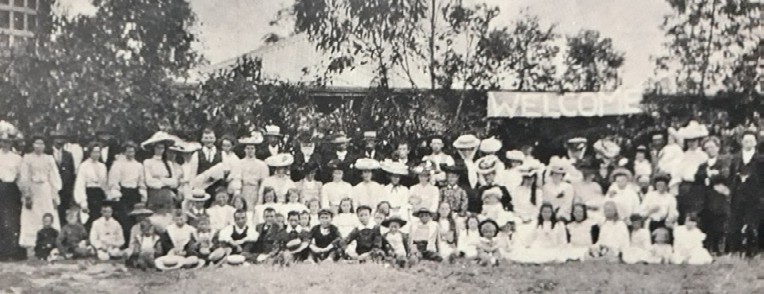
Welcome homecoming for James (son of George and Catherine) after serving and surviving all of W.W.1. Photograph courtesy Lynden Matheson
As an inducement for people to write about their experiences, first on two subjects (virgin scrub and scrub cutting and picking up), a prize competition was advertised; there were a total of 28 papers on the two subjects entered. Circulars were printed and distributed among the pioneers in an effort to gather as much information as possible, in order to compile their book. Numerous photos were also passed to the committee; some of the monthly meetings were held in Korumburra, many more were held at Bonnie Vale. With the early pioneers continuing to contribute by writing down their recollections and experiences, their memories of settlement, along with other regional developments and the economic environment of their time.
Thus, Bonnie Vale became the birthplace of what is now considered to be an iconic historical source of reference to the pioneer’s settlement, toil, and development of South Gippsland, captured in word and picture. George Matheson and his contemporaries’ brainchild had come to fruition when our pioneers first compiled their history of life in The Land of the Lyre Bird. The members of the committee formed to produce The Land of the Lyre Bird were the only pioneers who would receive a leather bound first edition of their book; unlike the other first editions that were bound in a thinner green coloured material, theirs were bound in a thick brown embossed leather outer cover.
My great grandfather had also purchased a copy of the green covered first edition. His committee members-only first edition was always to be seen upon my grandmother’s mantelpiece; regrettably its whereabouts are no longer known to us. His green covered first edition with his signature, as previously mentioned, was found by us 101 years after having been signed. As recently as 2022 while on holiday we were looking through a second-hand book shop in regional Victoria when we had a goosebump moment. We found his green covered first edition, which seemed to whisper to us “take me back to where I belong”. So it was that George Matheson’s personal first edition ended its century-long journey and returned to his descendants.
Fortunately, my great grandfather encouraged his daughter Georgina to take up photography. Georgina passed away at the very young age of 35 years leaving for the now widely cast descendants of George Matheson and his wife Catherine, a legacy of various and diverse subjects she had photographed at Bonnie Vale. Buildings both internal and external, family members and other towns and places in South Gippsland. Unfortunately, not all her photos have survived as some have been lost or maybe destroyed in some way. However, there have been enough seen to give an excellent and realistic view of early settlement and pioneer achievements in the Land of the Lyre Bird.
In later life my great grandfather took up the hobby of wood turning and produced a large array of wooden ornaments, bowls and walking sticks; three of the sticks he made we now have. After the sale of Bonnie Vale in 1923 to the Miles family, they removed a section of the homestead to provide a home for one of their family members. They moved that section of the homestead south, approximately three hundred meters from the present gateway into Bonnie Vale. A timber home is still standing on a sharp bend of the Korumburra – Wonthaggi Rd; within its walls there is remaining the basis of that home, a section from Bonnie Vale homestead.
Upon his retirement my great grandfather moved to Leongatha and a home in Peart St. which is still standing. After a few more years he then moved to Geelong and into a home that is also still standing in Autumn Street. George Matheson passed away at Geelong in 1941 aged 89 years, he had lived a long and fruitful life; he was brought back to South Gippsland to be interred beside his beloved wife Catherine in the Outtrim Cemetery. How ironic it is, that their final resting place along with several other pioneers in the Outtrim Cemetery Reserve, is now being encroached upon by stands of Eucalypt trees, including one highly endangered species. Trees that our pioneers over 140 years ago, strove to remove from the Land of the Lyre Bird.
An example of the religious convictions held by George and Catherine Matheson and family, is the poignant epitaph upon Georgina Matheson’s grave, it reads as follows – “Though thou hast called me to resign, what most I prize, it ne’er was mine.”
Today the only remaining tangible evidence upon our landscape, giving credence to George and Catherine Matheson’s fortitude in a wilderness that was once the Land of the Lyre Bird is, the original brass name plate of Bonnie Vale and an out building at Moyarra, also the grave stones covering their resting place at Outtrim Cemetery, upon which is inscribed – “Be ye also ready.”
0 Comments