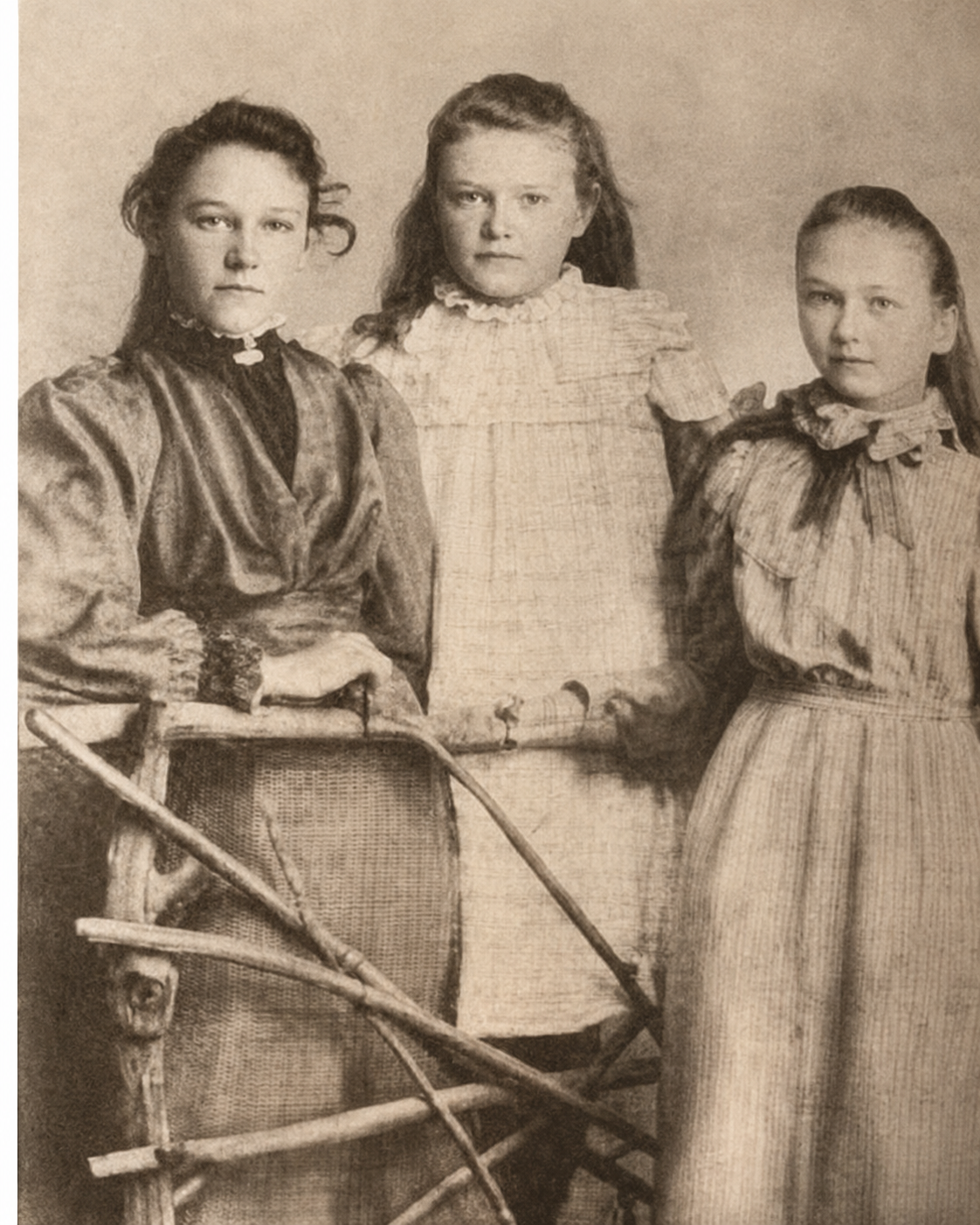
Jean Davies (centre) photographed with two other members of Korumburra pioneering families, Ethel Shellcot (left) and Margaret (Maggie) Langham (right).
Korumburra’s first Presbyterian minister, the Reverend George Davies, was so deeply impressed by the story of the rich young ruler in the new Testament who was asked to sell all his possessions give the money to the poor and follow Jesus … that the Reverend Davies did what Jesus had asked of the rich man… he sold all his possessions, including his and his wife’s wedding presents and gave the money to Korumburra’s poor, leaving his family in very straightened circumstances.
Reverend Davies came to Korumburra in May 1893, to set up the first Presbyterian ministry in the rough embryo coal mining town of that day.
The youngest of his three children, Jean Davies, who later became a doctor in Korea wrote a small history of the family’s stay in Korumburra and her childhood in the growing township. The account was recently presented to us by Dr. Keith Bowden, well known historian and author of The Great Southern Railway – Early Days of Korumburra, and several other historical publications.
Dr. Jean Davies story of her family begins with her grandfather in New Zealand. Her words follow:
My paternal grandfather who was practising as a lawyer in Wanganui in New Zealand came to live in Melbourne with his fourteen children where he thought their future prospects would be better than if they remained in New Zealand. My father joined the ES&A Bank and studied at night, graduating in Arts and Divinity at the Melbourne University.
His first charge in the Presbyterian ministry was at Allansford near Geelong where he married Anne, a daughter of the Reverend Thomas Hastie of Buninyong, whose long ministry there was famous. At Allansford my older sister Margaret was born. I was born at Buninyong in 1889 where my father had become assistant to the Reverend Thomas Hastie.
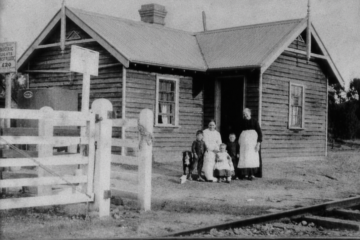
In 1893 my father, the Reverend George Davies, was sent to Korumburra to establish the Presbyterian Church there. On a Saturday morning of May 27 he arrived at the Korumburra railway station where he was met by a resident of Moyarra, formerly Jumbunna East, and with him rode out to Moyarra in pouring rain to conduct the church service the following morning in a log hut styled “The Academy”. It was attended by three men. Back in Korumburra that evening he conducted his first service there in semi darkness in the unheated Mechanics Hall on the Station street hill. The congregation comprised three men, two women and three children. It was an inauspicious start…without a manse, without a church building, with a wide parish to cover on horseback. He rode about the parish on a pony until the district was opened up and some ‘roads’ were carved out of the bush and a buggy was provided.
My father later welcomed his wife and three children at the railway station where we walked across the tracks and descended the steep stairway into Commercial street where a spring cart awaited us opposite Radovick’s hotel. We were bundled into a cart and driven down Radovick street to Guys road where a house was provided. We lived there for nearly twelve months until a manse was built in 1894. Sunday School was also conducted there. The Presbyterian Church, the Church of England, forward looking, had purchased a block of land in the original land sale.
The Mechanics’ Hall and the police station were also located on the hill as it was thought that the township would develop in that direction. The State School held its classes in the Mechanics’ Hall. It was approached by a track that threaded its way up the hill through a sea of mud between tree stumps. In winter children were sometimes literally stuck in the mud and had to be pulled out.
Behind the manse there was a vast forest where we as children roamed, pretending we were pioneers until the great fires of February 1898 swept the trees away and Cooke’s Hill became visible for the first time. A five acre paddock was cleared behind the manse where a cow was kept. We were taught by a governess, a Miss Henderson until we were of school age. School for us was not rigorous, but we were made to do the washing up.
There was a lovely garden at Kilynon, the home on Cooke’s Hill, which was often visited. We had holidays at Inverloch, Buninyong and Ivy Hill, the Langham’s selection at Ranceby, Mrs. Langham was our aunt. She was a daughter of Thomas Hastie of Buninyong. At Langham’s place we learnt to play tennis and became familiar with farm life. Langham’s house possessed a very good bathroom.
In 1895 I started school, attending the state school that was opened in Mine road in 1895. The Mechanics’ Hall had been removed from Station street to its present position in Radovick street. The subway connecting Station street with Commercial street was a great boon and made the state school much easier to access. The children went home for lunch. Mr. Williamson, the head teacher, was a strict disciplinarian. He
stood in front of the class with his cane tucked under one armpit and this attitude on his part was due to one of his favourite pastimes. It left his hands free to twirl the ends of his beloved moustache. This occupied a good amount of his time. Other teachers at the school were Miss Paliser whose subject was arithmetic, Miss Devlin, Miss Sevon and Andrew Bell who was an assistant. I had no aptitude for mathematics and was always a slob at sums. When Mr. Bothroyd the district inspector was due, the girls were asked to plait their hair and wear their best ribbons.
In 1905 the Presbyterians bought Woolf’s auction rooms and converted the building into a place suitable for church services. It was situated on the railway side of upper Commercial street close to the entrance to the railway yards. Erasmus Williams had a smithy nearer the gates of the entrance to the yards and the trucking yards were situated on the upper side. Woolf was prosecuted for burning a large stump in front of his premises in Commercial street and endangering his neighbouring businessmen. The Presbyterians held their services there until 1900, paying the annual rent to the railways department during their stay. My mother used to put her infant son to sleep behind the organ which she played for Sunday services.
After school my sister and I were given piano lessons in what became known as the Central Hall by a Miss Macrae, who had her own piano there after the Presbyterians sold the building and built and opened their own church in Radovick street in 1900. I remember carrying a bucket of milk down Station street, through the subway and down Radovick street to use for the numerous cups of tea drunk at the celebrations.
In 1899 my mother was not well. She was suffering from headaches, severe enough to disable her. Dr. Strahan prescribed a sea voyage for her, a common prescription in those days. My father resigned his appointment for supply and took my mother for a trip to England. In the interval, Aunt Mary came to Korumburra and managed the household.
One of my uncles had gone to Korea as a missionary. It had been his ambition to be the first white missionary in Korea, but some Americans preceded him. His sister, Mary, went to Korea to look after him. Disaster struck and when he had been in Korea about six months he undertook journey with two ponies 330 miles to Fuson. He arrived there ill and was taken to a Japanese hospital where he died two days later form smallpox. Aunt Mary came back to Australia and returned to Korumburra where she entertained our family with endless stories of her time with her brother in Korea.
I obtained my Merit Certificate in Korumburra and won a scholarship there in 1900. My sister and I were sent to Clarendon College in Ballarat where our mother had been a pupil. I was not very impressed with my stay at the college, as there was too much discipline and too much learning by rote.
My father was outspoken about several issues and his parishioners sometimes differed strongly with his views. He did not follow the usual routine adopted in a Presbyterian service at that time. He did not approve of the collections being taken up during the service and replaced it with a plate at the door for contributions. On one occasion he was talking to the congregation about the importance of children in the church and referred to them as the cream of the church. One of the mothers went to him to discuss the matter. If the children were the cream, was he inferring the parents were only the skim milk. “Oh no” he replied “you are the butter.”
Having learnt to play tennis in Korumburra I had no difficulty in becoming a member of the school tennis team. We usually lost our matches against Methodist Ladies’ College, as they had some outstanding players at the time. I also played in the school cricket team on the Melbourne Cricket Ground. It while I was at Presbyterian Ladies’ College that I decided to be a doctor and spend my life in Korea as a missionary. I decided on medicine to be different form my sister, Margaret, who had a brilliant career in Arts and Education at the Melbourne University. More seriously, I wanted to find out what doctors knew. My former headmaster at Korumburra, Edward Williamson, was transferred to the Caulfield district where I met him one day. He asked what I was going to do with my life and when I told him I intended to be a doctor, he replied, “Doctors are no better than butchers.”
My art class at Methodist Ladies’ College was instructed by one of Australia’s most celebrated artists, Walter Withers. His teaching about nature made a lasting impression on me and so did his reply to a question he asked me when we met one day in the Fitzroy Gardens. When I told him I intended to study medicine and go to Korea as a missionary Mr. Withers said women doctors were no better than nurses and in his opinion no-one had the right to convert people of other nations to their way of religious thinking. Undeterred by the opinion of Mr. Williamson and Mr. Withers I set about trying to raise the necessary funds to pay for my university education.
I took the position of a housemaid at my home on the provision that I was paid the equivalent of a housemaid’s wages. With additional finance from some relatives eventually qualified at Melbourne University in medicine in 1915 and obtained a position on the staff of the Children’s Hospital. The First World War was in progress. In Korea, a regiment of Chinese was raised to join the Allies in France. Dr. Maclaren who was in Korea, volunteered to go with them as the regimental medical officer. I was asked if I would take Dr. Maclaren’s place in Korea and this I readily agreed to do.
In 1905 Japan had defeated the Russians in Manchuria and Korea became part of the Japanese empire. When I arrived in Korea I found I could not practise medicine until I passed a medical examination in Japan. Travelling to Japan by sea, I found myself in a six berth cabin, sharing it with five men some of whom were Russians. I was asked, “Weren’t you afraid a man would run off with you?” To which I replied “No such luck”. Armed with a long hat pin I considered I was able to look after myself, and as an added advantage I had inherited a sense of humour and quick wit from my father.
In Japan, along with some American doctors who were also required to pass an examination, I went before a Japanese professor to be examined on the subject of diseases of the eye. The Japanese professor was weak in English but we managed to understand one another. I was finally given a certificate stating that I was qualified to practise medicine any where in the Japanese empire.
Then followed a long career in medicine, not only in Korea, but also retirement there, work on a leprosy survey in the New Hebrides for the New Zealand church and work among the Aboriginal [peoples] in outback Australia.
From “Took Testament Story Literally” South Gippsland Sentinel Times, 30 May 1995
0 Comments