As told by Douglas Harold Boston
 The Australian side of the Boston family began when William migrated with his family to Australia in 1857. They arrived on the sailing ship “Jessie Munn”, a ship of 874 tons carrying 303 passengers, it sailed from Liverpool on 19 July and arrived in Geelong on 9 November, a journey of 114 days. Not an enjoyable journey.
William’s family consisted of Jane his wife and five children: Thomas, Sarah, Robert, Maria, and Joseph. The family stayed with William’s sister Harriet who was married to Thomas Marriot a hotel keeper in North Melbourne. William’s occupation was listed as a groom, he soon started his own livery stable and cab business.
It was his taxi business that caused his demise. He picked up a fare in Fitzroy, a man and his wife and child and took them to the Post Office in Elizabeth Street. The man complained that the fare of one shilling and six pence was excessive and attacked William, knocking him into the gutter where he suffered a broken leg. He died two weeks later from a gangrene infection. The man was charged with manslaughter and was later acquitted. William died in 1862 only 5 years after coming to Australia, he is buried in the Melbourne General Cemetery.
Little is known about how Jane raised her five children, possibly with help from her family.
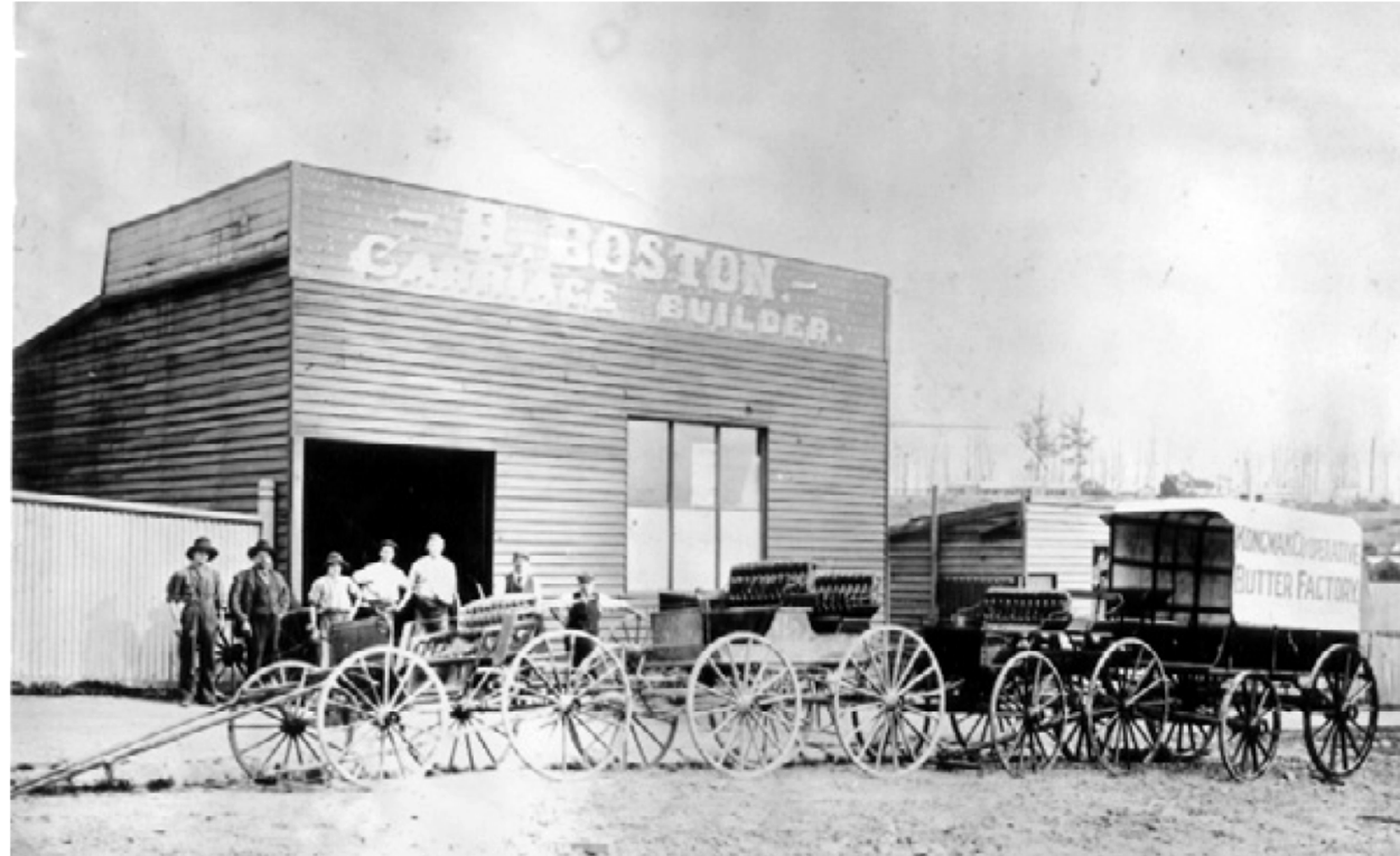
Now we come to my grandfather Robert, he was 4 years of age when came to Australia, he grew up in Melbourne and learned his trade of iron worker and coach builder. He started his own business in Carlton. The first advertisement for his business that we see was in 1884 for the “Carlton Iron and Steam Cutlery Works”.
His brother William joined the business and they contracted for many projects including the iron footbridge over the rail line at Benalla, the gates and roof trusses for the Melbourne fish market, the strongroom in the Exhibition/Parliament House and many other iron balustradings for shops and railway stations. Two sets of fish market iron gates are still in use, one at the entrance of the Faulkner Cemetery and the other the entrance gates of the Seymour Sports Ground. He had around 40 workers in his factory.
Unfortunately Robert’s business ran into financial problems due to the collapse of the banks and he decided to shift to Korumburra in 1893 where he opened his Blacksmithing and Coach building shop in Radovick Street.
Robert married Elizabeth and they raised five children: Harold, Arthur, Bessie, Olive and Vera.
Korumburra was a developing town due to the opening of the coal mines and the rail line from Melbourne being built. He ran a successful business building jinkers, buggies, farm wagons and sleds for the local community. He built most of the wagons for the Korumburra Butter Factory that were used to cart cream cans from the farms to the factory. The wrought iron fence on the ramp at the entrance to the railway station is one of his lasting achievements.
Robert died in 1918 and is interred in the Korumburra Cemetery with his wife Elizabeth and children; Arthur, Harold, Bessie and Vera.
Harold took over the running of the business from 1919 to the 1940s. He continued to do coach building and blacksmithing. He married Violet Tolson and they raised five children: Doris, twins Keith and Roy, Elva and Doug.
In the twenties he sold motor cars, “Ford Model A”, and Rugbies and built the bodies for the Albion trucks that the local butter factory used to cart cream cans from the farms to the factory. Harold had a struggle to keep the business going during the depression of the thirties and the war years, he kept it going until the return from war service of his twin sons Keith and Roy.
Prior to enlisting in the army Roy worked at the local butter factory and was said to be in the running as secretary. Keith trained as a school teacher and was for a short time teaching at Korumburra.
In 1946 I joined the family business with my father Harold and brothers Keith and Roy to learn my trade as a motor mechanic. I worked in the job for 49 years and retired in 1995.
I married Dorothy LeMaitre in 1954 when we built a new house and raised 3 children: Marie, Allan and Graeme.
Keith and Roy enlisted for army service in 1940 and did their training in various parts of Australia. While training in Queensland they had a one night leave and they celebrated in a local town. Roy was driving back to camp when he hit a tree and damaged the army truck, the military police charged him and gave him two weeks’ jail. Keith didn’t think this was fair so he would visit Roy in jail and stay there for a couple of days and let Roy go back to camp. They did this several times unknown to the jailers. They both served in New Guinea and returned from war in 1946, where they carried on the family business.
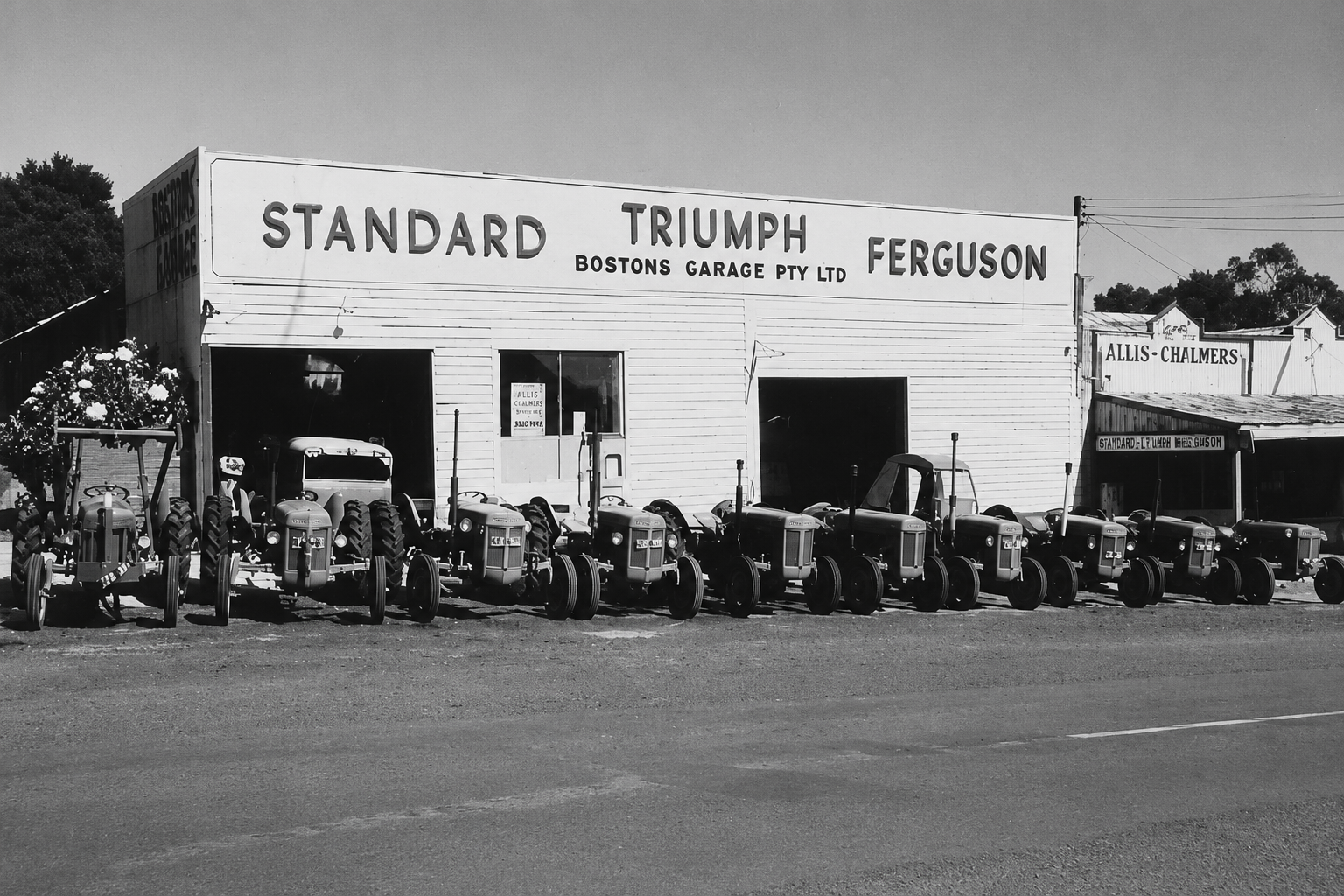
The business developed with the agency for Ferguson Tractors and Vanguard and Triumph cars. The tractors proved to be a revolution in the area with their high standard of manufacturing quality and ability to work on steep country. We sold 430 Grey Fergys and as many tractors again when the Massey Ferguson range arrived in the 1960s. We later sold Volkswagen, Toyota and Rambler cars.
In 1956 Keith arranged to sell electrical goods and television sets, this proved to be very successful when the Olympic Games were on in Melbourne. We had one of the first televisions set up in the showroom where the public could come and view the Olympics on the black and white 17 inch screen, the place was packed every night.
In 1973 Keith decided to build a steel yacht in the back yard of the shop, it was completed in 1974 and entered in the Sydney Hobart yacht race. The crew consisted of Keith, his 2 sons Peter and Geoffrey, Rod Delbridge local dentist, Alan Lapin local doctor, and a nephew from Tasmania. They completed the race coming 92nd out of 95 competitors. They passed through the eye of a cyclone off Bass Strait and the yacht fell down sideways off the top of an enormous wave causing Alan Lapin to break his arm.
In 1995 we celebrated the centenary of the establishment of the business. Held over two days, the Friday was for the customers with an open invitation to a barbecue lunch, while Saturday was for past and present staff for a get together and lunch.
The employees numbered 92 from the 1950s to the 1990s. The business was sold to Donald Wylie who carried on the mechanical repairs for several years, until the premises were sold to Roger Davis. The end of Boston ownership after 120 years.
List of employees 1950s to 1990s.
Employees in early days are not recorded.
Boston family involved in running the business from 1940s: Harold, Keith, Roy, Doug.
Bill Richards, Neil Joyce, Mick Adams, Bill Olsen, Bruce Drysdale, Lester Trewin, Jim Mioni, Allan Perks, Mike Enbom, Ray Birch, Doug Lay, Jim McNiven, Ed Kock, Alan Barnes, Herb Kemp, Maurice Williams, Jack Chapple, Wally Lewis, Arthur VanBoven, Donald Wylie, Len Wyhoon, Shaun Johnson, Keith Black, Ian Celebrine, Garry Lamb, Bob Stewart, Winton Platt, Walter Capelli, Ted Elliott, Greg Dowel, Peter Wilkinson, Brian Mitchell, Y.N. Smith, Harvey Pearce, G Richards, George Murphy, Tom Mackie, Barry Waite, Bruce Klemke, John Barham, Barry Douglas, Chris Stone, Natalie McCord (Hayward), Ian Riddell, Horace Brady, Tom Symonds, Betty Worthy, Dorothy Smullen (Harland), Lynne Chapman (Perks), Jan Dixon (Miles), Anne Godfrey (Reeves), Judy Bell, Joy Jefferies (Allan), Avis Weller (Peacock), Jeanette Dixon (Whelan), Pam Checkley (Reeves), Denise Jeffries (Logan), Val Brown (Reeves), Joyce Kershaw (Holm), Val Gooch, Lynne Perks (Chapman), Nancy Smith (Lousada), Nancy Humphrey (Summerfield), Chris Muir (Pellaizarri), Leonie Dean (Stewart), Norm McPherson, George Adams, Ian Hurst, Jim Mathieson, Len Worcester, Bruce Eden, Peter Suffield, Jamie Cashin, Anthony Smith, Ian McKay, Allan Macqueen, Tom Perks, Phillip Cowling, D. Maloney, Ray Durkin, Bob Cayzer, Merv Ryan, W. Whitling, Alan Herald, Ed Aldersea, Amy Boston.
0 Comments