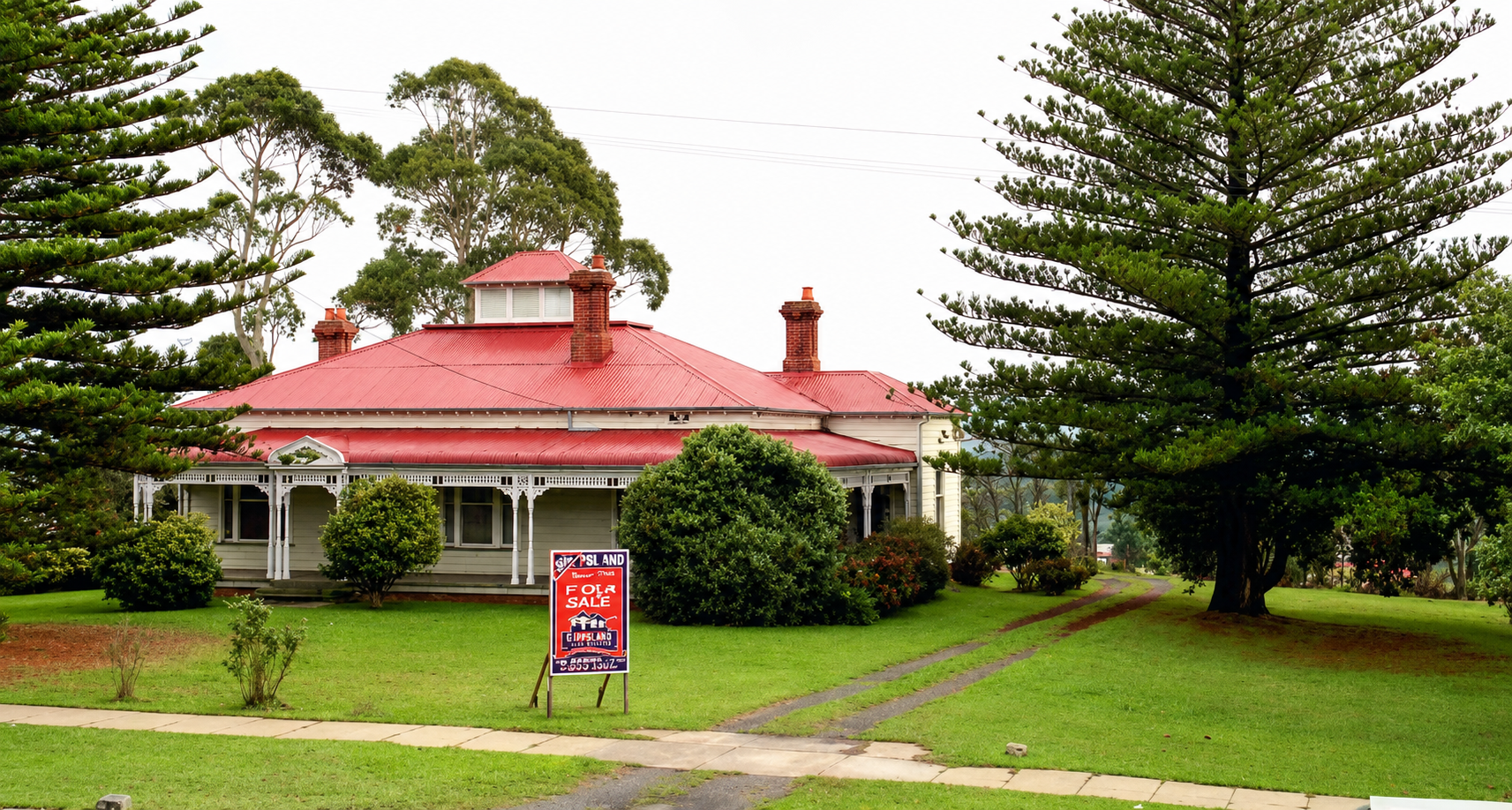
1988 “Developer’s Opportunity”
“Braeside” at 52 Radovick Street with its three Norfolk Island Pine trees is a landmark property in Korumburra.It was lucky to escape demolition in 1988—and what a loss that would have been to the heritage landscape of Radovick Street. By 1988 it had had four owners in the previous seven years, had failed to be sold at auction, and had languished on the real estate market for 7 months. It had the air of an abandoned house teetering on the brink of irreversible damage and decay. By April 1988 it was being marketed as a “developer’s opportunity”, poised to be replaced with units. This article covers the history of the house, as we know it, up until that time.
The story of “Braeside” for the first twenty years is also the story of the Edwards family. Francis Edwards (1833-1897) was a successful grazier from the Coghills Creek area west of Ballarat. He was so successful, in fact, that his obituary states that he was able to retire to “live privately in Mair Street, Ballarat.” But, “leisure became irksome and being tempted by the very favourable reports of the richness of Gippsland forest land” he acquired land in the Jumbunna area from 1882. Ultimately Francis, his wife Ellen, and seven of their eight adult children relocated to the Glen Alvie/Korumburra area.
In July 1897 Francis Edwards died after a short illness and was survived by his widow, Ellen. Their eldest daughter, Mary Banks, took over the running of his successful agricultural property, “Barregowa,” in Glen Alvie.
“Braeside” was built in 1899 by James Edwards, the second surviving son of Francis and Ellen Edwards. Prior to this James had been practising law in Ballarat but he was well known in the Korumburra area through his family. While living and working in Ballarat James had also acquired land in the Jumbunna/Korumburra area including, in 1892, Crown Allotment 77 in Radovick Street for £45.
In February 1899 the following notice was inserted in the *Building Engineering and Mining Journal* by the well-known Ballarat architect, F.W. Turton, stating “Tenders wanted for erection of 9 roomed WB villa for Mr J. Edwards, solicitor, Korumburra”. In April 1899 James Edwards commenced work as a solicitor in Korumburra. He bought Crown Allotment 76 in Radovick Street in May 1899—after work had commenced on building the house on Crown Allotment 77. James likely chose allotment 77 carefully as it allowed him to position his house prominently on the crest of the hill in Radovick Street. It is interesting to note that the three Norfolk Island Pines are planted on his original block and were probably planted around the time the house was built. These are now more than 30m tall.
The *Great Southern Advocate*, April 28th 1899 pronounced that “By appearances Mr Edwards has evidently come to stay as he is having a very handsome villa built in Radovick Street…” However, in February 1900 James dissolved his Law Partnership in Korumburra and sold his two farms in the Jumbunna area. In July 1900 he married Mary Combe in Sydney and they emigrated to South Africa where James became a distinguished magistrate. All records for James, his wife and children indicate they settled permanently in South Africa.
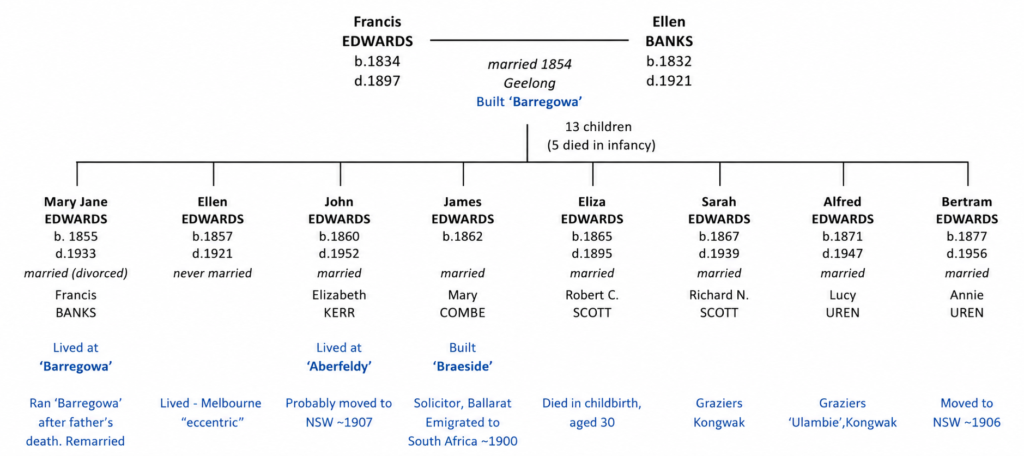
James’ mother, Ellen Edwards, became the second owner of “Braeside” in 1905 but electoral rolls have her resident in Korumburra earlier than this, presumably at “Braeside”. One wonders if it was never James’ intention to make “Braeside” his home and that he organised the build for his recently widowed mother. Ellen was born in Scotland so it maybe that she was the one who named the house, “brae” being the Gaelic word for “hill”. “Braeside” returned to the ownership of James in 1913 but Ellen was the only one ever on the electoral roll in Korumburra.
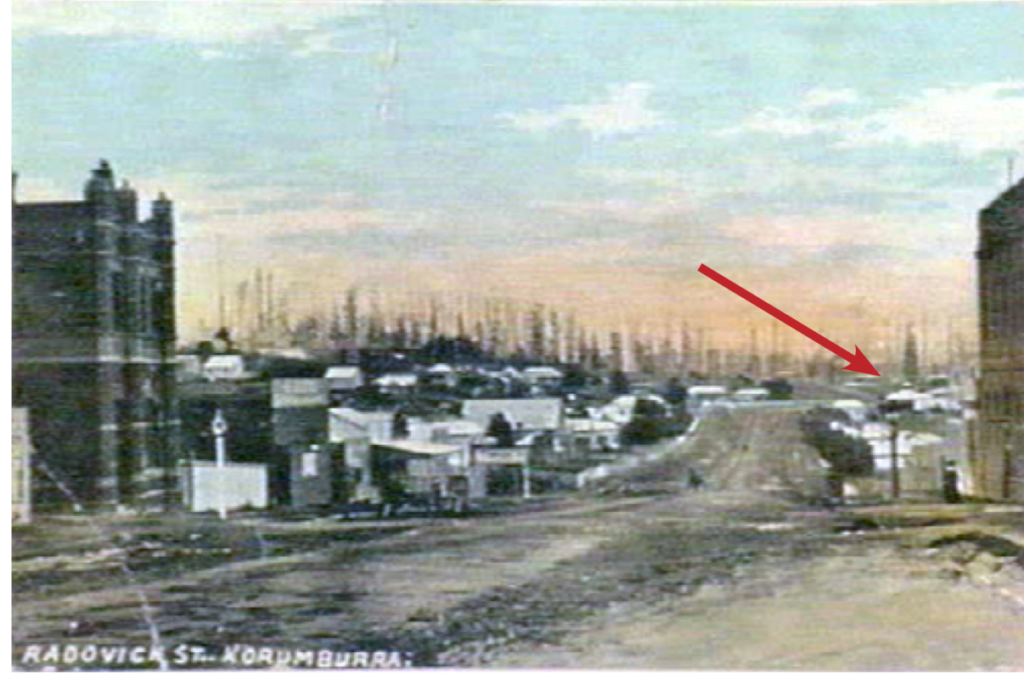
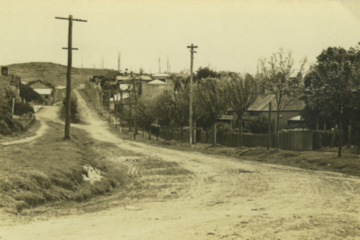
Radovick Street Korumburra
The house was sold in 1920 and Ellen died the following year in Hawthorn.
On 1st July 1920 the following notice appeared in The Great Southern Advocate: “Mr P. Hudson has purchased Captain James Edwards’ property in Radovick street, consisting of large dwelling and cottage, with paddock at the rear…”
Peter Hudson owned “Braeside” from 1920 until his death in 1959. He was a well-known local identity being owner of the Austral Coal Mine and a very active long-time Shire Councillor. His black Daimler was housed in a detached stable to the rear of the home.
Peter Hudson, a bachelor, left the house to his widowed housekeeper, Rubina Duggan, and she owned it until 1968. She briefly ran the premises as a wedding reception venue. Rumour has it that she was so appalled by damage done to her newly laid parquetry flooring by stiletto heels that she soon abandoned this venture. She subdivided crown allotment 76 and sold part of the frontage to Drs. M. and A. Lapin for construction of their medical centre.
Laurie and Joan McGrath owned “Braeside” from 1968 until 1980 and it was during this period that the house was divided into three flats. Between 1980 and 1987 “Braeside” had four different owners (R. & P. Delbridge, B. & M. Nugent, R. Welfare, and R. Groves). While it seems these owners hoped to restore the property, they faced a losing battle with any progress that could be made in only a year or two of ownership being outstripped by the rate of decline. Rod Groves, who had briefly run the property as an antique shop, took the property to auction in October 1987 and there was a huge attendance. But people were only there to buy the ‘goods and chattels’ with literally everything being sold off from antique furniture to a box of household cleaning products. No-one was there to bid for the house and it was passed in. “Braeside” stood empty and deserted, falling further into decay and marketed as a “developer’s opportunity”. But even the developers lost interest. By April 1988 Rod Groves was desperate to sell and in May 1988 “Braeside” was purchased as a family home by the current owners, Greg and Marion Shuttleworth.
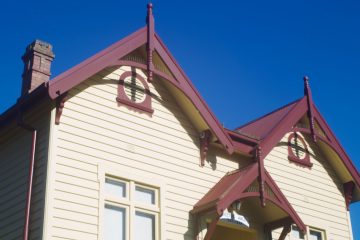
Architecturally the “9 roomed WB villa” designed by Turton is a large transitional Victorian/Federation weatherboard residence. The most eye-catching feature is the unusual clearstory lantern on the roof that floods the interior with light.
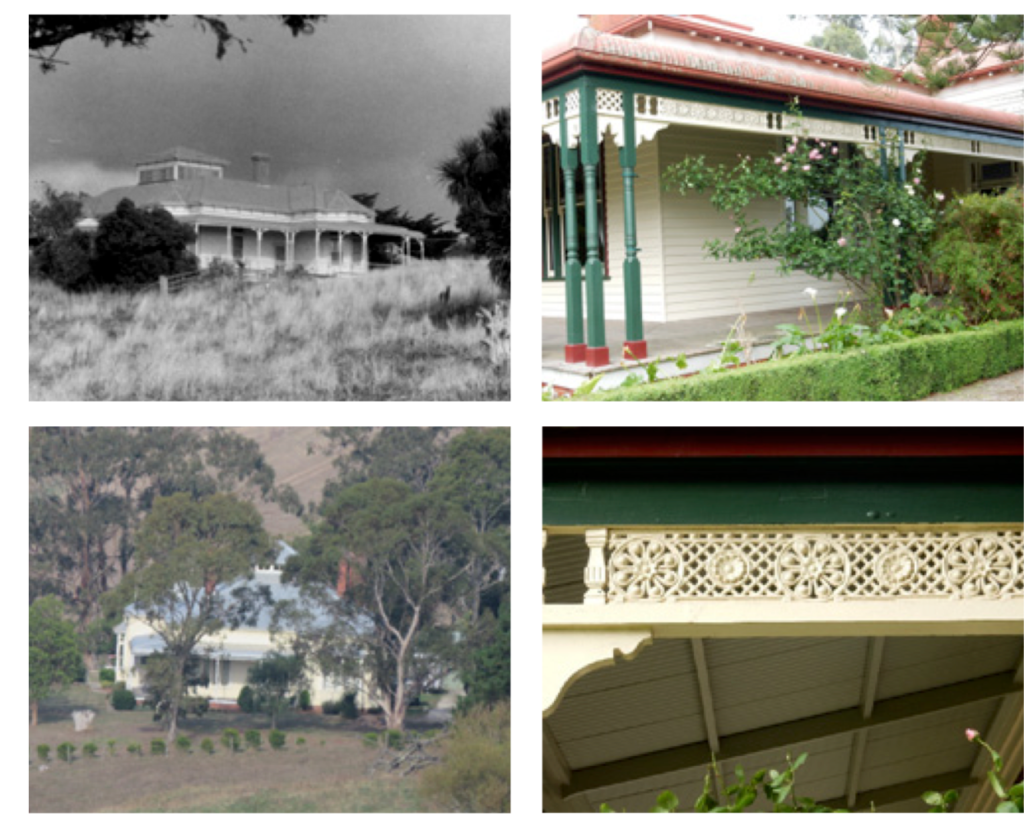
Top photograph shows “Aberfeldie”, Loch Road near Mackay Road, Glen Alvie and below is “Barregowa”, Wade Road, Glen Alvie, taken from Glen Alvie Road. The connections to Ballarat continue as the ironwork adorning “Braeside’s” return verandah is the standard commercial streetscape iron pattern for Ballarat c. 1900.
Of interest Francis and Ellen built “Barregowa” (Wade’s Road, Glen Alvie) and their eldest son, John, built “Aberfeldie” (Loch-Wonthaggi Road, Glen Alvie). Both these houses still stand and both also have clearstory windows. One wonders if all three houses were designed by Turton, particularly as this architectural feature also appears in “Eyres House”, a notable house he designed in Ballarat. There are rumours that there may have been a similar fourth house built in the Korumburra area by a younger son. The connections to Ballarat continue as the ironwork adorning “Braeside’s” return verandah is the standard commercial streetscape iron pattern for Ballarat c. 1900.
Since 1988 “Braeside” has been home to the Shuttleworth family. Greg and Marion thought it would take about ten years to restore the house and create a garden. Their increasingly inaccurately named “Ten Year Plan” is, in 2024, simply described as “ongoing”, and after 36 years of DIY they’re pretty sure the house owns them!
“Braeside’s” charm is amplified by the streetscape it shares with other heritage properties and through the history of this town, Korumburra. “Braeside” has stood for 125 years and is safe for now, but like all our heritage buildings its future remains uncertain.
0 Comments