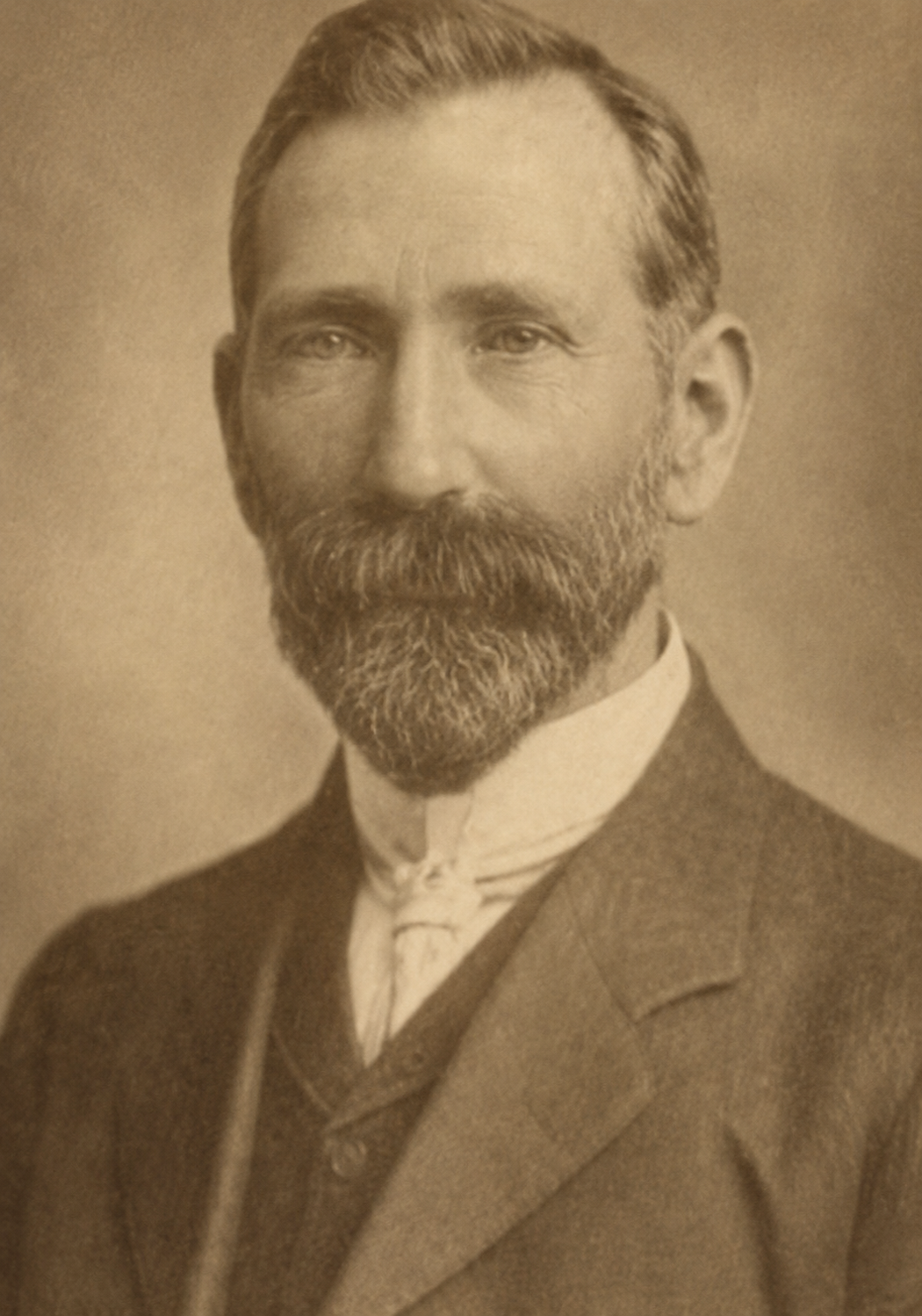
 By Dennis Conn
It would seem that due to the mists of time, the passing of a generation and population change, knowledge of this man in South Gippsland has all but been lost.
A memoir of him by author Oswald Stuart Green “The Ensign Bearer” – Businessman-Churchman-Philanthropist, gives a detailed account of this man and his contribution to Victoria’s development and social history. The Ensign Bearer can be found on Google by typing in the name of that memoir, where a most informative and interesting read is to be found.
While the memoir mentions his purchase of properties in South Gippsland, his contribution to the improvement of those properties and the business arrangements between himself and individuals, mostly those having shown initiative and hard work in order to better their own lot in life is not mentioned therein. That aspect is to be found in the verbal history of a man known to a generation of local and regional residents as Mr Edwards. Their business experiences and knowledge of that man being passed down to family members by those who had engaged with him, especially during a period of our history that was blemished by economic down turn i.e. the Great Depression and the 2nd World War.
The following are just a few of the details known about Robert Campbell Edwards, other than his time in South Gippsland, for which acknowledgment must be given to The Ensign Bearer, published by The Campbell Edwards Trust in July 1981. After being widowed, his mother encouraged by her brother who was living in Melbourne, emigrated to Australia as the effect of the potato famine in Ireland was still being felt. With her came, Robert then aged fifteen years and his younger brother Thomas aged fourteen years. The three of the afore mentioned emigrated to Australia in 1877 and lived in the Melbourne suburb of Richmond.
Robert gained employment with a wholesale grocer in Bourke Street Melbourne, where he worked in the tea and coffee department tasting and blending tea.
In 1881 he established his own tea and coffee business which thrived, Edwards and Company Ensign Tea had the slogan, “there is only one T in Australia”, one of his tea tins with that slogan on it, is in the Echuca Wharf Museum. The first five story building erected in Flinders Street Melbourne housed Edwards and Co. He purchased a great many metropolitan properties, both business sites and private homes. Robert Edwards was an outstanding business man and also deeply religious, he used his wealth to assist his church and those less fortunate than himself. The Burwood Boy’s Home (later becoming the Burwood Children’s Home) was founded by Robert Edwards in July 1895. In 1922 the Edwards family set up the Robert Campbell Edwards Charitable Trust. Still active today as it continues to benefit many charitable organisations.
Mr Edwards was known to have purchased rural land in a considerable number of districts throughout South Gippsland and when he sold those properties, they were reputed to have been in a far more productive condition than when first purchased. Weeds such as blackberries, ragwort and thistle having been brought under control. He owned properties in the Nyora, Loch and Whitelaw districts to name just a few. At that particular time the greatest challenge came from the wild rabbits that were in plague proportions as they consumed pasture in massive amounts. Mr Edwards made every effort to poison rabbits on his properties but it was not until much later, rabbit proof fencing and biological control became available and rabbits were depleted.
Of particular interest to my wife Val’s parents was his ownership of several Whitelaw properties Stanley Ricardo spent much of his youth on a property near to the end of Sullivans Road, a property with a title of approximately eighty acres covering both sides of the ridge that the road followed. Mr Edwards owned and named that property Emerald Hill, a wooden home stood atop the hill, just a few metres south of where our brick home now stands. The property was never owned by the parents of Stanley Ricardo but most likely was used to share farm on. Unfortunately Stan’s mother passed away while they were living on Emerald Hill.
Stan and Dorothy née Clark married at Loch in 1934; during the fifth year of the ten year long global economic depression that ran from 1929 to 1939. They took up share farming for a living, doing so on several South Gippsland properties. Stan and Dorrie were share farming at Mount Eccles when Stan’s father approached them asking them to come and live with him and work the Emerald Hill property at Whitelaw. That property had a cow shed, however the cows were milked by hand as electricity was not available during that time at Whitelaw.
Stan Ricardo’s reply to his father was “only on condition that he could buy the property from Mr Edwards”, and so an approach was made by Stan which resulted in a mutual agreement between himself and Mr Edwards which resulted in Stan and Dorrie’s purchase of Emerald Hill. Stan built a new larger more modern milking shed when the electricity became available. It was during those years when they first dairy farmed on Emerald Hill that Mr Edwards owned an adjoining property to the south-west of Stan and Dorrie. His property was rather steep but had a hut built on the only flat area near the western arm of the Foster creek.
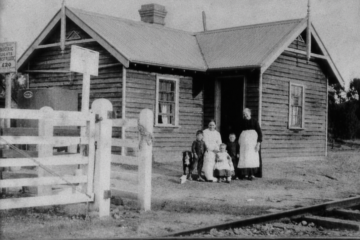
During that same period, being the later years of Mr Edwards life, he would come from Melbourne by train to the Whitelaw station. His son Campbell would phone Stan and Dorrie to ask if they could collect his father from the station and take him up to his property, which Stan did gladly. Campbell also asked if Stan would check each morning to see if smoke was rising from the chimney of his father’s hut which would indicate that his father was active and OK, as he was no longer a young person. During those years of fiscal difficulty and the war time period when there was a shortage of fencing materials and some food or cooking items while many other items were rationed, Dorrie found it near to impossible to buy enough sugar to in order to bottle fruit. Mr Edwards would on occasions bring a bag of sugar with him from Melbourne for her and also fruit which was more affordable at the Melbourne markets. His generosity was much appreciated and never forgotten by Stan and Dorrie.
Stan and Dorrie always spoke very highly of Mr Edwards, they said although a frugal person, his preparedness to sell them their first property during such difficult times and gain ownership of a dairy farm that was to secure their future within the local dairy industry was greatly appreciated.
The passing of Mr Edwards in 1946 was lamented by local and regional residents who knew him, or had done business with him. His improvements to the rural properties he owned then later sold, or opportunities given by him to those who laboured long and hard to purchase their own property during those demanding or difficult times and conditions, all served to enhance some aspects of the then local and regional rural industries. He through his actions and business arrangements provided greater employment opportunities and security for a number of people who were then part of a generation striving to build a secure future for their themselves and their young families.
I urge all Historical Society members and others to search on Google for the The Ensign Bearer there one may read a very detailed and interesting memoir of the life and times of Robert Campbell Edwards 1862-1946, a man who left a legacy that remains and is ongoing today. The life and times of Robert Campbell Edwards and his contribution to our then growing rural industries in particular, the opportunities he had provided and the properties he improved, is not readily acknowledged within our recorded history. Verbal history is not looked upon as having unquestionable veracity as did the contents and publication of The Land of the Lyre Bird. Those who hold memories of having been given a verbal history of events regarding people and places, not only in South Gippsland but other regions, should look to recording those family histories and stories and pass that information down to following generations.
Surely the memories of this man in particular should not be allowed to disappear into the mists of time, and should be available within our Historical Society’s records. There may well be other regional families that hold within their historical knowledge, a favourable acknowledgment of this man who was generous of spirit, hard working and made a significant contribution to the development of rural industries in South Gippsland. A man known by a generation of the Ricardo family as Mr Edwards, one who gave them their first opportunity to purchase their own property, to improve on and further develop their own dairy farm, while always remembering Mr Robert Campbell Edwards.
0 Comments