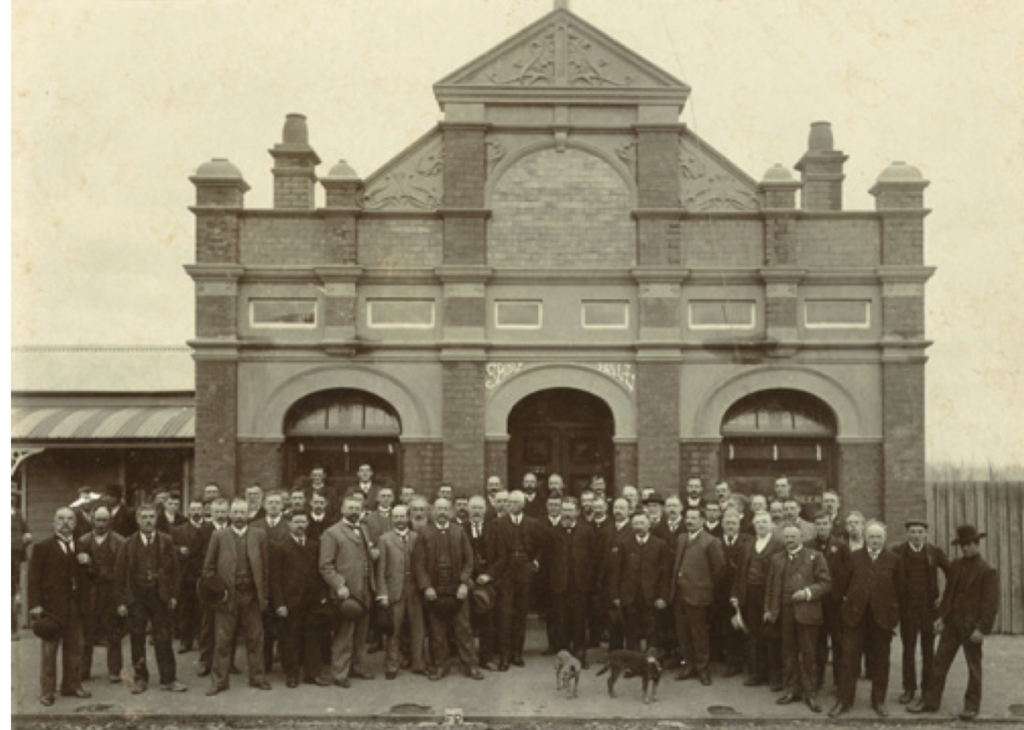
The building that was used as the Shire Offices from 1907-1956. The Apex club was given the contract to demolish it in 1960.
The following anecdotes were prepared by Doug Boston, for a talk he gave at Carinya some time ago. He focused on some of the interesting events and people that are written into our history.
Post Offices
There have been six sites for the post office.
The first in 1890 in Shepherds General Store in Commercial Street on the north east side where the Caltex Service Station now stands which was on railway land.
The second location in 1891 was in Shepherd’s new store on the south west side, opposite the old store.
The third in 1894 was in the shops that Antonio Radovick built next door to the Korumburra Hotel. One of these shops was occupied by the National Bank.
The fourth, in 1904 was on the corner of Bridge Street and Mine Road the brick building, now occupied by the Police Traffic Unit. Neil Falconer was the builder.
The fifth in 1973 was at 10 Radovick Street, formerly the site of a boarding house, and next to the Sentinel Times Office.
The sixth is at 30 Commercial Street, a new brick building on the site of Lester Wyatt’s Electrical Store.
The Central Hall
Three shops, numbers 16, 18 and 20 Commercial Street are presently owned by Robert & Annette McDowel. Grace Burnet, daughter of James Burnet, original owner of the Burnets Iron Mongery business, wrote some diaries from 1892 to 1903 in which she referred to the Central Hall as the place of meetings and singing practice.
The history of this building dates to 1892 when it was built by Mr. W. Woolf as an auction room. He used it until 1894 when he rented it to the Presbyterian community for use as their church. In 1895 he decided to sell the building, and the Presbyterians were forced to buy the building and pay the lease of the land to the Railways. They used this building until 1900, when they built their church in Radovick Street.
The Central hall was used as a public meeting place for many years, and was later to become a billiard room in the 1920s. Charlie Fowler, Arthur Mercer, Herb Petersen and Ken Joyce at different times ran the billiard room.
Later, a brick division was built and made into small shops. This shop and Tonkins Plumbers next door would be pulled down and a new bakery/cafe built by Gilbert Kelly in 2001.
Cordial Factory
Another interesting businessman in Korumburra was James Lawrence. He started one of the early Aerated Water Factories in the town and produced the Lyre Bird brand of drinks. His factory was located in the south side of lower Commercial Street, at the rear of the Picture Theatre site. His house was next door to the Shire Office (formerly Huckell’s Emporium.) Lawrence was very successful and was able to sell his product all up and down the rail line—which provided the transport when the roads were in poor condition.
One story of interest is when he had a problem with the taste of the drinks. They had a peculiar foul taste so he investigated and found eventually that the problem lay in the pipe coming from a spring further up the hill from which he obtained his water supply—there was no reservoir at that time. The pipe was an old lead pipe that had been used for gas in Melbourne. Once this was replaced the problem was solved. Lawrence sold his business in later years to Billy Dobell who set up at the rear underneath Dicky Devlin’s shops in Mine Road. Later owners were Ebsworth, Harry Goad, and finally Colin McLean, who changed the brand name to Joe’s.
In later years James’ two sons ran the ‘Lawrence Bros’ picture theatres in Korumburra and throughout South and Central Gippsland for many years. James was also owner of the Cromwell Hotel (Bena) for many years.
Shire Office
The first Shire Office for the Shire of Poowong and Jeetho, which was annexed from Buln Buln in 1890, was built in Jeetho. The council was meeting in the Athenaeum Hall in Poowong and they sought a more suitable permanent home. Hosking saw an opportunity to centralise the shire business in Jeetho, so he offered to donate the land and erect a suitable building which he would also donate to the Shire. The Shire accepted his offer and used this office until 1908, when they saw the need to move to Korumburra, which had become the business centre due to the development of the coal mines.
In 1907 the Shire was offered the brick building in the lower section of Commercial Street owned by Mr. Huckell. It had been used as a drapery store and was called Huckell’s Emporium. The price asked was 600 pounds. The shire thought this was too much, so they delayed their decision for another twelve months, and bought the building for 700 pounds. This was the Shire Office until the new shire offices were built in 1956. The contract for the wrecking of this building was given to the Apex Club around 1960.
School
The first school in Korumburra was in a tin shed where Alex Scott’s business is in Bridge Street. The building was actually the first post office building which Mr. Shepherd donated to be used as a school. He had the building shifted in 1890 and re-erected on land belonging to his daughter. This building served as a school until 1891, and then the Mechanics’ Hall on top of the Butter Factory hill was used until 1895. Some 300 children attended school in the hall. The hall was shifted to Radovick Street in 1895 and school was held there for a short time until the new school in Mine Road, which was shifted from Clunes was ready.
The tin shed Post Office/School was burnt down in 1897. The hay and corn store next door belonging to Hurlestones caught fire and, there being no fire brigade at the time, both buildings were destroyed. This event caused such public concern that a fire brigade was formed in 1898. A building to house the equipment was erected on the site at the top of Commercial Street, a fire tower and bell were added in 1901.
Antonio Radovick
Antonio Radovick (Antun Radović) was one of the first to realise the potential of the embryo township. He bought the best commercial blocks in the town and built his hotel on the Corner of Radovick and Commercial Streets before the rail line had reached the town to haul out the coal.
As part of his license agreement Antonio had to finish the hotel by the end of January 1890. Radovick had every available bullock wagon carting materials from the rail at Drouin, and had most of the timber mills in the area supplying him with timber. It was said that there was a worker for every plank of timber being used on the building. He opened on time and threw a party in a huge tent at the back of the hotel.
He was indeed the father of Korumburra. His hotel was the meeting place for all types of organisations. The Catholics held their first church services there; the football club was formed there in 1892, with Antonio as its first President. He gave land for the shifting of the Mechanics Hall from Station Street and was instrumental in the running of the first Agricultural Show there. He was instrumental in protecting the recreation grounds, ensuring their use as sporting activities rather than from land developers, selling the site for housing.
Radovicks’ paddock where the early sporting and racing meetings were held, became the showgrounds when he sold the paddock to the Agricultural and Pastoral Society. Antonio died in 1903 aged 65, thirteen years after coming to Korumburra.
‘Dicky’ Devlin
Bernard Devlin was one of the characters of the town. He bought his business in Mine Road in 1903 from William Smith for £30. He was a tobacconist, hairdresser and grocer. Some of his shop fittings and shelving came from Dwyers Grocery (later tobacconist) when they closed down their grocery business next to Burnets in Commercial Street. Devlin purchased in bulk for cash and passed on the savings to his customers. He purchased candles by the ton, and kerosene by the railway truck load before the days of electricity. Devlin’s generosity to those in need was well known, he helped many families with gifts of groceries. One of his slogans was ‘The Cheapest Grocer in Australia’.
A shave and hair cut with the presentation of a cigar at the conclusion of the operation—all for sixpence. All purchasers of groceries were presented with a free bag of lollies. All the kids went to Devlin’s to pick up the pound of butter or whatever mum wanted, they knew they would get their bag of lollies—a great sales promotion. Devlin’s son Jack worked with his father and he is remembered for his bicycle with the basket on the front that he used to deliver the groceries around the town.
Oliver Gilpin
Oliver Gilpin’s first O’Gilpin store was established in Mine Road, Korumburra in 1895. In 1923, the business moved to Commercial Street. After occupying two different sites, Gilpin built his own store on the upper side of Wrench’s Shoe Shop. Gilpin was an astute business man; he bought direct from the manufacturers and sold to the public, cutting out any middlemen. Gilpin expanded his business over the years and finished up with 94 stores throughout Victoria and Tasmania. It is said that Gilpin was the founder of the first major drapery chain stores in Australia. He sold to Foy and Gibson in 1944 who later became the Coles Chain Stores.
His granddaughter Muriel Perry has written a book on the O’Gilpin history Just a Pocket for the Money an appropriate title as Oliver only employed women to work in his stores. The head lady wore an apron containing multiple pockets to hold the takings, all the shop assistants took the money to her and she issued the necessary change—no tills.
No red heads were given employment and his ads stated that ‘Catholics need not apply’. The only men he employed were to drive the lorrys that delivered the goods to the stores.
Oliver was very strict with his staff and demanded total honesty and loyalty. He had a book of rules for the employees and these were strictly enforced. He set the example and expected everyone to follow.
One motto was:
“I lead, follow who can.”
Other mottos included:
I lead, follow who can.
Wasting time is stealing.
Keep your mind on the job, otherwise you will find you have no job to keep.
I don’t care what you do at night, but if you do half as much the next day—as I expect—you’ll last half as long as you expect.
Don’t kick if I kick. If you’re worth keeping, you’re worth correcting.
A good person never sees temptation when they meet it.
Initiative is doing the right thing, at the right time, without being told.
0 Comments