The following is an extract of Jillian Durance’s address to the November meeting of the Korumburra & District Historical Society—about the Kogwak Avenue of Hounour and its remarkable story.
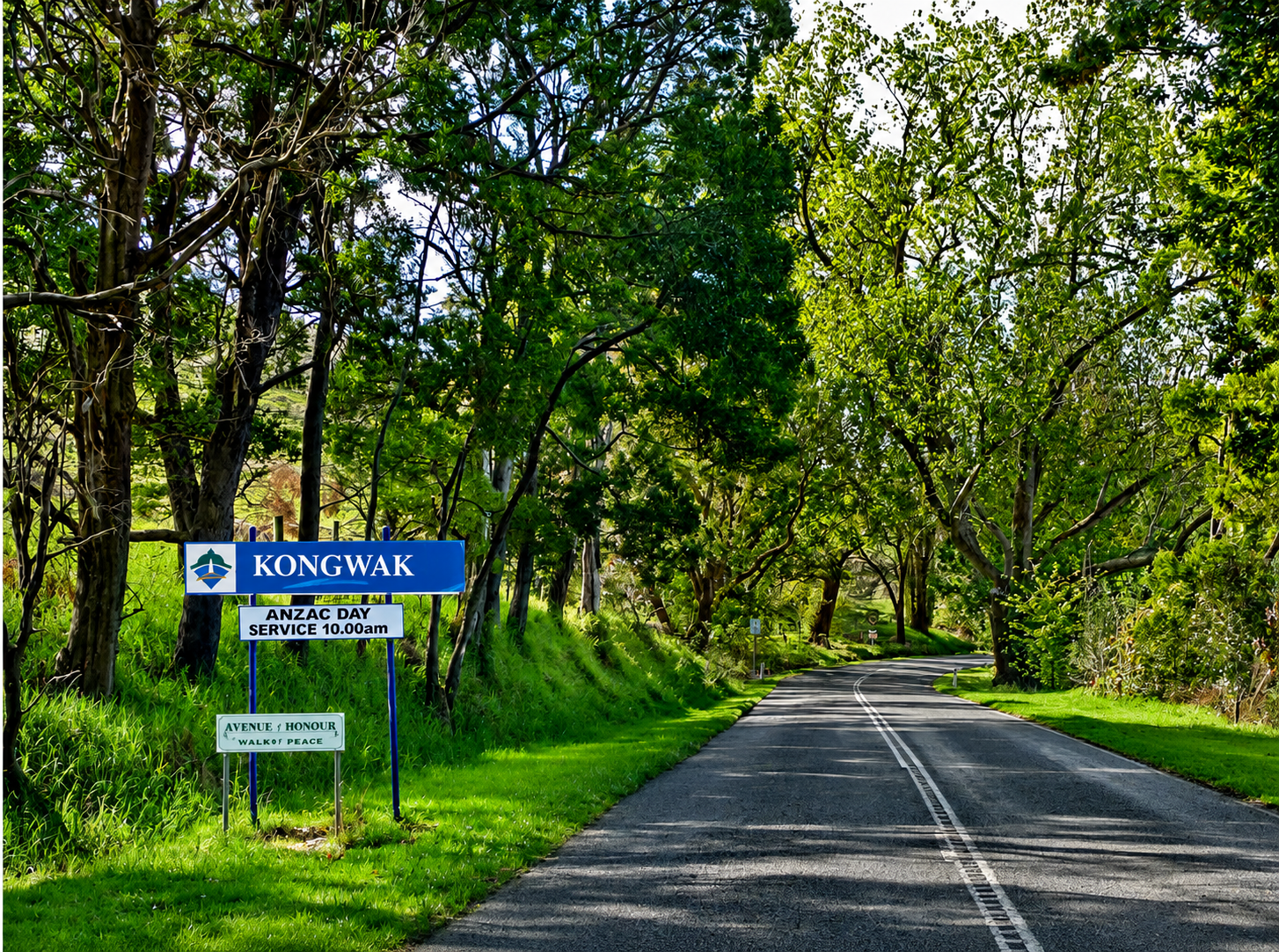
Thank you all for this opportunity to speak on one of my favourite topics, the Avenue of Honour in the little town of Kongwak, not far from here, fifteen minutes on the road to the coast, home to 46 permanent residents, a few weekenders and many others in the surrounding farmland. And to those living elsewhere who have never really left.
As you drive through to the coast one way or toward Korumburra, at either end of the town you will drive through an avenue of deciduous trees. Lombardy poplars, turkey oaks, English elm, pin oak, horse chestnut, and outside the hall, a magnificent Bunya Bunya Pine. You’ll also see a sign that says Kongwak, Avenue of Honour, Valley of Peace.
A number of locals have told me that they have always responded to that sign valley of peace, as a kind of mantra for their way of life there. Some wanted to come and live in Kongwak, because of that sign, but I would like to suggest that the term ‘valley of peace’ has more to do with the fact that we have an avenue of honour planted as a memorial to those who fought for peace during the Great War and the Second World War, in the years that followed. While I do not know how the term ‘valley of peace came into being I do know that it was current at the time of the Kongwak Centenary back in 1983.
Kongwak is said to mean STOP or CATCH. It was first visited by the Bunurong, who, it is said, came to fish and trap eels in the Foster Creek, just upstream of its confluence with the Powlett. Surrounding slopes were thickly covered with eucalypt foothill forests, fern laden gullies. The farmland was hard won.
From 1883 it was settled and cleared by pioneers with names like Scott, Armstrong, Rainbow, Halford, Tulloch and Williams. Over the first 20 years they built their homesteads, a hall, a church, a school.
Sited on the banks of Foster Creek Kongwak was an ideal location for the butter factory that was established in 1896, collecting cream from the surrounding farms. By 1914 it employed dozens of people and supported a store, workshops and Post Office. Butter production was in full swing when Britain declared war on Germany on 4 September 1914.
Young men were encouraged to enlist, not always at first, but after the retreat at Gallipoli, their families were convinced and confident that it was their duty to enlist: to do their duty for God, King and Country and that’s what so many of them did. In Kongwak and district alone 40 did so. A recurring and repeating picture all over South Gippsland, Victoria, Australia, the Brtiish Empire. The women were there too. Nurse Matilda Rainbow offered her services to take care of the wounded.
The War Years
Let’s zoom in and see what this meant for this little slice of rural life in the depths of those years 1914 to 1918. The enlisted recruits were farewelled at the hall, presented with watches, sometimes waved goodbye at Korumburra station. Schoolchildren stepped into the shoes of older brothers, milked cows before and after school, knitted socks in their spare time often on the way to school. Some could turn a heel without breaking their stride. They trapped and sold rabbits, raised chickens, grew potatoes. Kongwak State School raised the highest amount for a school its size, a total of £600, amounting to $65,000 in todays money. And all for the war effort. Women joined the Red Cross knitted socks, mittens, balaclavas, sewed pyjamas, packed food tins for the front. Patriotic concerts were held at the hall. People paid to listen to musical items, poetry recitations and to eat a sumptuous supper only the women of Kongwak could provide. Families waited eagerly for the mail deliveries hoping for letters from the front sharing those letters when they arrived and avidly reading the Great Southern Advocate for little news that was available to them at the time.
Mrs Euphemia Williams was also busy raising funds, working on the school committee as she had 9 children altogether, two at the front, the youngest still in school. She was also busy writing a chapter for The Land of the Lyrebird, whose publication had be delayed not only by the war but by the fact that the editors were very keen to have more articles written by women. Euphemia wrote so eloquently of her early misgivings and struggles.
‘I have reason to believe,’ she wrote in 1917 or thereabouts, ‘I was the first white woman to come to Kongwak and my second son was the first child born there. While I write, he is on the battlefield in France, fighting for his King and Country, with, I trust, the same courage and tenacity his father showed when trying to make a home in the forest of South Gippsland.’
It was also in 1917 a year before the Great War (as it became known later) was over that the avenues of honour began to be planted throughout Australia, particularly in Victoria. Ken Inglis in his iconic text Sacred Places claims that compared to other forms of monument like cenotaph, arch, statue, the avenue of honour was a novelty, and very much a homegrown Australian endeavour. Inglis writes: ‘The first examples were planted during the war in response to an official initiative when the Victorian State recruiting committee wrote to all municipalities and shires in 1917 recommending that an assurance should be given to every intending recruit that his name will be memorialised in an Avenue of honour.’ Among towns which responded Ballarat was committed by 1918 to nearly 4000+ trees. Our Shires of Poowong and Jeetho and Woorayl locally also responded and planted avenues. Leongatha and Wooreen were the first to organise the trees on the local level. Followed closely by Kongwak, Koorooman, and Toora, and 3 others.
It is important to realise that because of the huge distance between the battlefields of Europe and Australia there were no bodies returned to their homeland. The idea of honour rolls, public monument and avenues of honour were the closest people could get to remembering their loved ones in a public way. The memorial movement began long before the war was over and continued in the few years following.
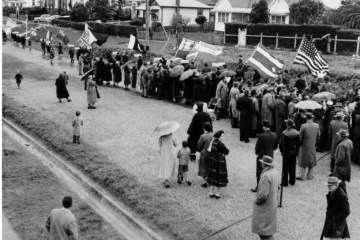
Let us go now to August 1918 outside the hall at Kongwak where it is today, opposite the school. These words are from the article written in the Great Southern Advocate a few days later.
‘Magnificent weather smiled upon the large gathering that attended last Thursday for the ceremony of planting an avenue of trees in honor of the boys who have enlisted from that district. The site is between the Kongwak school and the bridge, and a band of willing workers under Mr C. D. Tulloch, president of the hall committee, had prepared the ground, (Charles Tulloch also planted the first tree a Bunya Bunya Pine, a native of Queensland, a popular tree at the time) while the arrangements were carried out by the secretary, Mr H. Tate (also the headmaster at the school).
After the singing of the National Anthem (God Save the King), Mr W. J. Williams told the history of the movement (of the origin of the idea for an avenue of honour) and paid a touching tribute to the noble sacrifice made by the boys at the front.
The Rev. A. Brain, in extending his congratulations to the residents in planting such a beautiful memorial, said that he believed they were conducting the war for the cause of right. Rev H. Williams said that ‘we were a peace-loving nation but because of the principles that were at stake we were compelled to unsheathe the sword. The trees planted would be a living memorial—a token of honour to the brave lads, a tribute of honor to the people who planted them.’
Mr D. C. Briggs said they had a feeling of pride that they belonged to the men who had built up such a wonderful volunteer reputation for Australia. Our tribute was a small one but all our effort must be directed towards helping returned men. Shire president, Cr R. N. Scott, congratulated the promoters, and said he would like to see similar avenues in other parts of the shire. After the speeches the relatives and friends of soldiers planted about 40 trees. Refreshments were afterwards served at the public hall.’
Among those honoured on that magnificent August Day were men who did not return to Australia. Among them was Albert Farrar, one of the first to enlist from Kongwak, a grocer at the store, who sailed from Australia to Egypt, then Gallipoli and who was torpedoed on the Southland, fought on the peninsula then killed on September 25, 1915 and buried in the Shrapnel Gully Cemetery.
Also Henry Edward Dusting who was killed and buried in France; his mother Mrs L Dusting played the piano at the fundraising concerts, we hope she would have been there to plant a tree in his memory. Each tree could tell its own story. Lance Corporal Charles Thomas Wilton, a fine gentlemanly, soldier well liked, machine gunner of the 22nd battalion was awarded a military medal for ‘conspicuous bravery and devotion to duty’ at the battle of Broodseinde Ridge in Belgium, for ‘extraordinary focus, coolness and skill’: he was later killed 19 May 1918 at Villers-sur-Ancre, by an exploding shell as he went ‘over the top’.
But to me the most poignant of these stories is that of Alfred George Wesley Williams, son of William and Euphemia Williams of ‘Ferndale’, Kongwak, who were there on that day, no doubt with many of their children. Their son and brother Alfred was killed on September 20, 1917 at the battle for Passchendaele. He had no known grave, his name being commemorated now on the Menin Gate Memorial in Ieper in modern day Belgium. While we have no way of knowing which tree was planted for him I like to imagine that it is one next to the Bunya Bunya pine, the Pin Oak as both Mr and Mrs Williams were members of the Hall Committee and Euphemia herself was the secretary of the School Committee. Courage and tenacity in another way those people had, despite their loss, their grief, to just keep going. Courage and tenacity demonstrated by those who returned to see their trees grow.
At war’s end many of the returned took up soldier settlement blocks that were carved off some of the original selections. Some were able to make enormous contributions to the local community. Among them were Alf’s younger brother Francis Oliver Williams, two remaining Armstrongs and the three Pinkerton brothers, of whom Alex Pinkerton served as the Kongwak ward councillor in the Korumburra shire. Also among the returned was the redoubtable Bill Hair, soldier settler who helped form the Korumburra Senior Citizens and later in 1945 the Kongwak Branch of the RSL which turned its focus toward assisting the returned of the Second World War. They also turned their attention to the commemoration of those who did not make it. An honour roll was unveiled in the hall and the avenue of honour extend westward from the Foster Creek toward the western edge of the town.
Unfortunately I have yet to find records of how that branch of the Avenue of honour came into being. I know that some ex-servicemen took an interest in the trees that have been planted for them. I also know that in this case they were marked with a name Plaque.
For many years Anzac Day commemoration took place in the Kongwak church, but these days a simple ceremony is held at the head of the Avenue of Honour outside the hall where the original planting ceremony had taken place. People can stand under those glorious trees now well over a hundred years old, and listed on the register of Significant Trees of South Gippsland. They can place a wreath at the cairn unveiled on Anzac Day 1999 and read the names of those who served Australia in times of war. Kongwak’s Community Group in 2019 restored part of the Avenue of Honour with new trees. A quiet simple ceremony takes place on Remembrance Day. Last year the school children made and laid their own poppies.
The Church Road Avenue of Honour
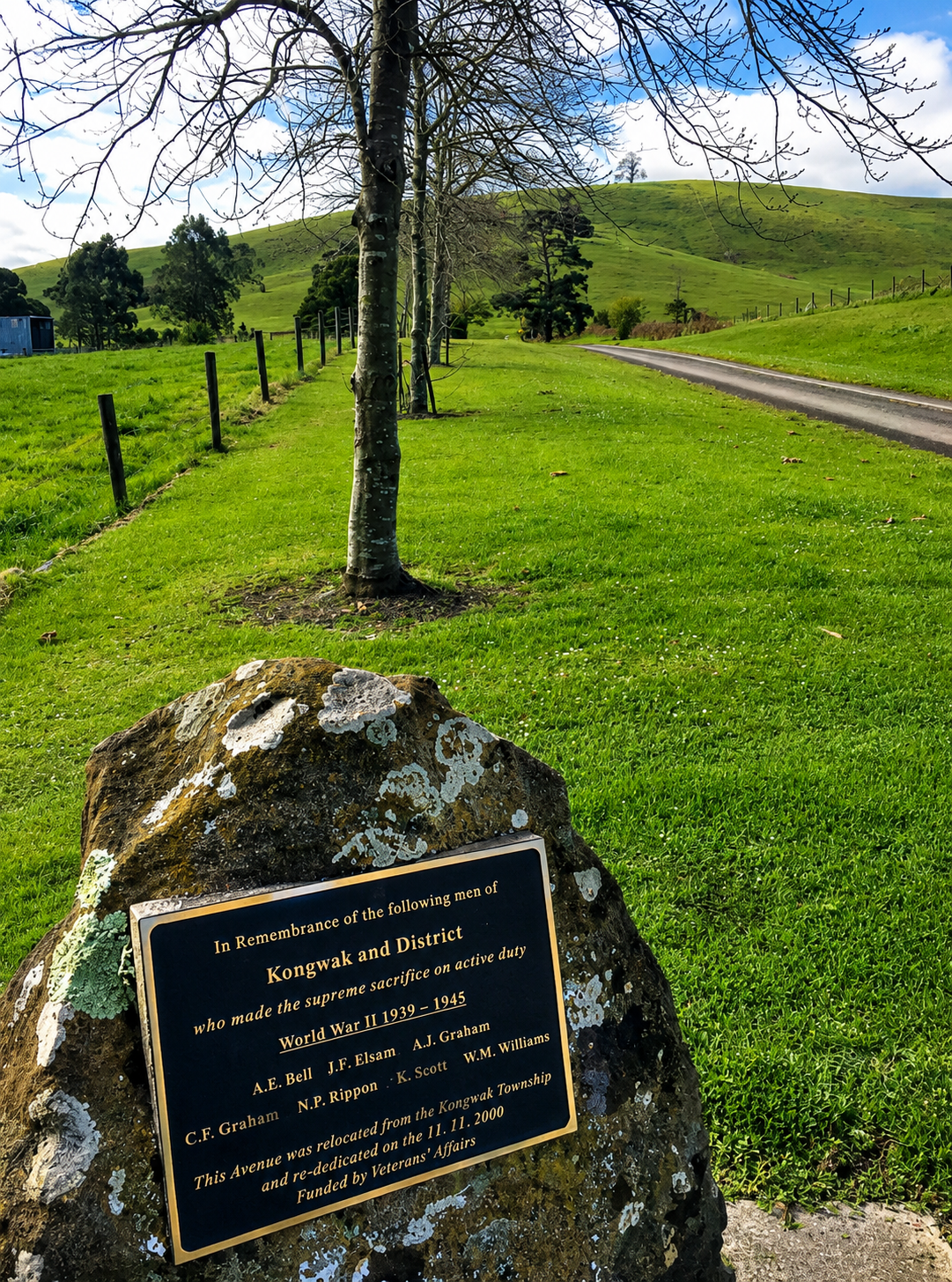
In 2009 seven new trees were planted to further extend the avenue around the corner into Church Road an initiative of the late John Gow OAM who wanted to renew his commitment to the memory of his friends who did not return as he had.
The seven trees, all hardy Pin Oaks with their memorial cairn were dedicated to the memory of seven young men of Kongwak who lost their lives in service to their country between 1939 and 1945. All were known to John Gow who initiated the avenue out of concern that previous trees planted for the men were either in need of replacement or were in vulnerable positions closer to the town centre. He sought assistance from the Department of Veterans Affairs and achieved his goal with the avenue dedicated 15 years ago on Remembrance Day 2009.
Among those who are commemorated are Norman Rippon and Christopher Grabham, both members of B Company 29/22 Battalion of the local militia who were killed in 1939 in an accident as they made their way into training in Korumburra.
Also commemorated are the airmen Lawrence K Scott and Alan F Bell, and Arthur James Grabham, school captain of Leongatha High School in 1939, shot down on his second only flight over the North Sea, 2 days short of his 21st birthday. Arthur had attended Kongwak State School with John so was a very close friend.
Also commemorated are James Elmore and Wesley Murray Williams who died as prisoners of war on Ambon. Jimmy Elmore and John Gow were in the militia together and were meant to sail overseas together but as John explained to me, due to his own illness his departure was delayed so he escaped his friend’s fate, who as a member of Gull Force was captured, imprisoned then died in captivity.
Family members and their descendants still visit their trees in the Avenue of Honour. Their graves are far away in Ambon, Scotland, Alexandria and England.
All memorials were very much grass roots as so much of public life was back then. Kongwak’s tribute to its fallen and returned was no exception. The local people put their own stamp on what was a national movement. Kongwak’s Avenue of Honour is of great significance due to its length, its development over the years, its place in community life, its continual care by the people of Kongwak, its diversity of plantings and sheer number of trees (about 70 strong). Its place on the Victorian heritage register, its place as living memorial to those affected by war. Its beauty. Its importance in the history of South Gippsland. Its role and identity as one of our sacred places.
0 Comments