Dennis Conn shares with us memories of his father’s wartime service
Armistice Day 2024, now known as Remembrance Day, was getting close when Perry Neil asked me if my son Travis and I would attend the service conducted by the Korumburra RSL at the Cenotaph in Coleman Park, and assist with the unveiling of a plaque at our Lone Pine tree, commemorating the Battle of Lone Pine on the Gallipoli Peninsula, Turkey, during the First World War.
I began to ponder why Travis and I would be so honoured and privileged to take part, although we are both affiliate members of the RSL.
The answer lay in Perry knowing that my late father was a returned serviceman from the First World War and, in particular, that he had taken part in the initial invasion of the Gallipoli Peninsula on the morning of Sunday, 25 April 1915. Perry explained that the RSL was looking for local people who had family connections to First World War returned servicemen who had survived, or had fallen and paid the ultimate price in what became known as the Great War, or the War to End All Wars.
We accepted the invitation extended by the RSL members, and I was asked to put together a brief account of my father’s military service and his life before and after. The following is the compilation of what I had prepared for Perry, although, out of necessity, it had to be shortened because of the time allotted.
It is as follows:
On this day of remembrance, as we acknowledge the Battle of Lone Pine—one of the most horrendous battles that took place on the Gallipoli Peninsula—we may also reflect upon our early military history, from which valued aspects of our social life and customs have evolved.
We should also remember that there were many First World War servicemen from our community who lived to return home. However, many others paid the ultimate price.
One returned serviceman who came to Korumburra after the war and became a local resident was William (Bill) Conn.
Bill lived at Richmond and, at eighteen years of age, enlisted in the military for three years, qualifying as a signaller. Upon leaving the military, he became a plumber.
After the declaration of the First World War in 1914, Bill enlisted for service abroad with the Australian Imperial Force as Private No. 503, D Company, 6th Battalion, 1st AIF. He was twenty-four years of age.
On Sunday morning, 25 April 1915, the 6th and 7th Battalions of the 1st AIF arrived at Gallipoli. Bill was aboard the troopship Galeka.
In later years, Bill was known to have spoken only once about the Gallipoli landing, when he said:
“We hit the beach and tried to dig in as the Turks raked us with gunfire from the cliffs. Those who could not dig in or find cover to hold their ground were cut down by the Turkish firepower.”
That was all his family ever heard from Bill on the subject.
On that fateful day he was shot through the hip and, sometime later, was taken from the beach to a hospital ship. Fortunately, he survived his wounds from the Gallipoli landing. However, his military records show that he developed a heart condition and was considered fit only for light duties.
After 527 days abroad, he was repatriated home. In 1917 he re-enlisted for service in the Base Postal Unit, Melbourne.
The direct descendants of Bill Conn still have the original Telegram postmarked Richmond, 26 May 1915, informing his mother that he had been wounded. Also among his possessions was a handwritten letter from King George V, Buckingham Palace, which ends with the words:
“A grateful Mother Country thanks you for your faithful services.”
— George R.I.
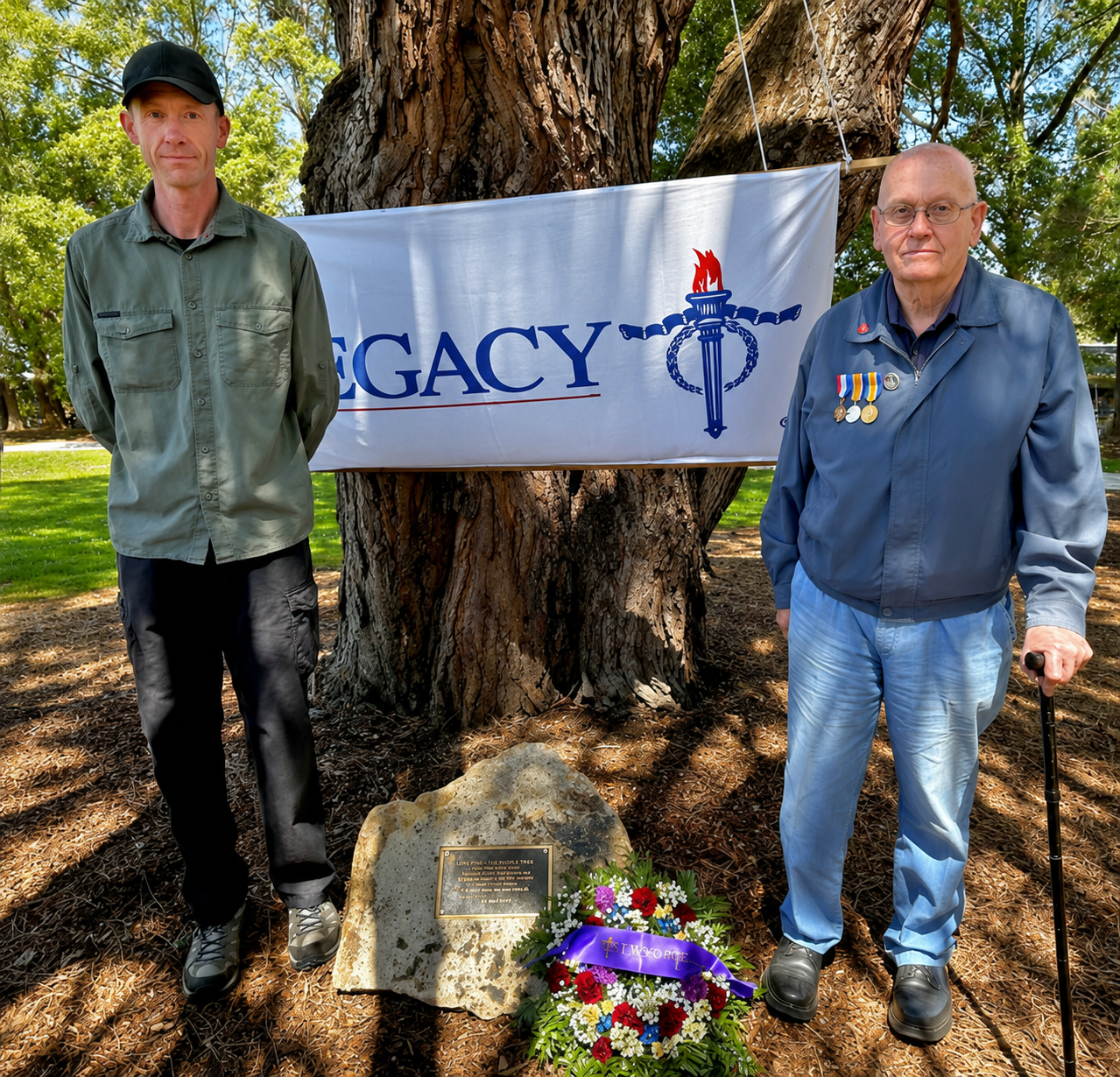
Travis and Dennis Conn at the unveiling of the Lone Pine Plaque
At the end of the war Bill came to Korumburra and worked as a plumber for the Victorian Railways. After retiring he moved to Kongwak, where he joined the local RSL. Bill passed away in 1968 at the age of seventy-eight, a few days after his birthday.
His service medals, colour patches, hat badge and lapel badges, embossed with the 6th Australian Infantry Regiment and the Latin motto Nulli Secundus (“Second to None”), remain highly valued reminders of Bill Conn, who became a long-term local resident and demonstrated a strong sense of commitment to his God, King, Country and the British Empire.
As previously mentioned, several years after his retirement my father moved from our Korumburra family home to Kongwak. He lived in a bungalow built at the rear of the home of my eldest sister, Leila, and her husband, Andrew Smith, on their dairy farm on Bena Road. He remained living with them and their family until he passed away.
In addition to his military memorabilia, there were several other war-related items that he valued, one of which had previously hung in the lounge room of our Korumburra home. It was a large framed certificate of appreciation for his First World War service to the British Empire, presented by the Mayor, Councillors and Citizens of the City of Richmond.
After my father moved to Kongwak I never saw that certificate again. As young as I was, I never gave it much thought, and it also passed out of the minds of my older siblings.
In 1984, when my sister and brother-in-law sold their Bena Road farm to Neil White and retired to Inverloch, Neil contacted my sister Leila to tell her that he had found, in an old garage, a large framed Past Officers’ Certificate inscribed:
“Presented to W. Conn in recognition of services rendered to the Australian Railways Union, Victorian Branch, as President of the Korumburra Sub-Branch in the year 1941.”
Leila was not particularly interested in it, perhaps because of the size and condition of the frame or because she had nowhere suitable to hang it in their Inverloch home.
Neil then asked me if I would like to have it. I greatly appreciated his kindness in thinking of me and replied with a definite, “Yes, please.”
When it came into my possession it was obvious that, although the large and ornate certificate remained in good condition, there was dust inside the glass and the wooden frame had noticeably deteriorated. I decided to remove the backing to clean both the certificate and the glass, and to see whether it could be reframed.
On the day I removed it from the frame, I could scarcely believe what I found between the back of the Railways certificate and the backing board. Hidden between the two was my father’s certificate acknowledging his First World War service to our nation and the British Empire, presented by Richmond City Council.
The certificate measures 50 × 40 centimetres. Its centrepiece is a written declaration of his war service bearing the common seal of the City of Richmond. Surrounding it are elaborate decorative embellishments, some in colour, including the words “The Empire called us” and the flags of the Allied nations: Great Britain, the Australian Red Ensign, France, Russia, Japan, Italy, Serbia and Belgium.
It also features a black-and-white photograph of the ANZACs at Gaba Tepe beach, together with portraits of King George V, Lord Kitchener and Sir Edward Grey, placing particular emphasis on the Gallipoli landing.
Part of the declaration reads:
“Signaller W. Conn, 6th Battalion, who volunteered for and served in the Australian Imperial Force in the Great European War begun in 1914, a hearty welcome upon his return to this City. The Council desires to convey its grateful appreciation of his loyal action.”
It records 641 days of service, including 527 days abroad, before continuing with a tribute to those who fought and died in the First World War. It is signed by the Mayor and two other representatives of Richmond City Council and dated 14 May 1916.
The wording provides a glimpse into the social attitudes of the period. Hidden where it was, the certificate remained in excellent condition for nearly thirty years. One must assume that Bill placed it behind the Railways Union certificate when he moved to live with his daughter at Kongwak. Why he chose to do so we will never know, but in doing so he preserved it in near-original condition. Thanks to Neil White, it was ultimately returned to his descendants.
Now reframed in an oak frame from the same period, my father’s certificate of appreciation is one of my family’s most treasured possessions. It hangs in our home, now 108 years after it was presented. It reminds and informs our family, including our children and grandchildren, of a turbulent and catastrophic period in our nation’s early history.
It also reminds me of the man from whom we are descended—a man who survived the ANZAC landing at Gallipoli and lived through the uncertainty of two world wars. The legacy William (Bill) Conn bequeathed to his family of seven children is that of a First World War soldier who, as a young man, was committed to his God, King, Country and the British Empire.
Lest we forget.
____________________________________________________
Featured Photo by corina ardeleanu on Unsplash
0 Comments