By (Wanderer)
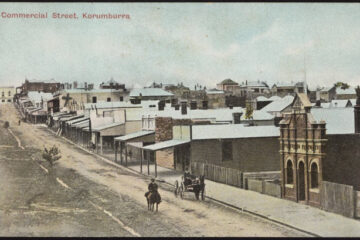
Korumburra, like most new bush townships, is not the pleasantest spot to see and live in, even for a day when the thermometer registers 130, dust flying, no baths, no cold shandy-gaffs, and no lounge to loiter in and be enlightened with intelligent talk emanating from equally intelligent settlers. But all the new townships in Victoria, as elsewhere in our colonies, have many advantages.
There’s the break away from so-called “society rules” and “starchiness” the offhand trading, the equally off hand clasp of the hand, with “Old man how does it with you?” In short, there’s an easy style and yet a genuine manner of trading, dispossessed of that smartness that borders on what we term “getting at you”, that in human nature is seldom met with in large cities.
Korumburra is a growing town in the centre of a large shire, Poowong, and Jeetho, and about twice the size of Newport. When first the shire was formed, there was no such place as Korumburra, and the interests of Poowong, Jeetho and Loch, were the ones watched over by the councillors. These places are still most strongly represented, Korumburra only having one representative on the Council, and as the districts named are the reapers of the progress of Korumburra, they say they do not get anything like their fair share of attention; and a glance at their roads, paths and drains seem to indicate it.
The progress that has been made is truly marvellous during the past twelve months. There is now a population of 3,500, and the town boasts of some creditable buildings. There are two banks The Australasia and the National said to be kept busy, a number of good stores, a couple of first class coachbuilders and saddlers, two coffee palaces, and churches galore, including the English, Wesleyan, Roman Catholic and Presbyterian.
Korumburra has two newspapers – The Southern Mail and Times, published twice a week. I’m introduced to the proprietor of the Times by an old Williamstownian, Major Douch, J.P. The Major’s introduction consists of a letter, written only as a friend would write, and on presentation, had the desired effect of getting a few items of news and an apology for not having time to show me round. Mr. Brown of the Southern Mail, I find also very busy on presenting my credentials and humble self but he is courteous, kind and considerate – as brother pressmen generally are.
I read both journals, and ask which is the conservative organ and which the liberal or radical one. The answer is very simple and very good – “We have no politics here, but coal, and the advancement of Victoria’s future greatness.” Sensible Times and equally prudent Southern Mail people. Stick to your mines and the future advancement of your country and give little heed to politics.
The Mechanics’ Institute contains a large library. This is used as school, court house, assembly, &c, and is in a most unsuitable position. For months the people have been agitating for removal, and at last the Lands Department seem to have awoken from their lethargy, and removal may be looked for soon. So let it be.
To business then and coal. Pessimists who confidently predicted that coal would never be found in payable quantities in Victoria of commercial value must feel themselves very small potatoes and few in a patch this present moment, for what gold was to Bendigo and Ballarat, so I predict coal will be to the whole colony of Victoria. Why? Let me give friend Patterson’s words as we discussed the prospects generally and the Coal Creek Proprietary’s outlook in particular.
They were, “I honestly believe that Victoria will not have to look back to other colonies for coal inside the next thirteen generations, even if no other discoveries take place in Victoria. Just look at what we have on our property: there are the samples taken from our five seams, and yet we have only bored 600 feet down. Just think what those seams means. The first was found at 80 feet, and is 4 foot to 4 feet 9 inches; the second was disclosed at 410 feet, and is 4 feet 6 inches; number three was reached at 486 feet, and proved to be 5 feet 6 inches, while like a sociable article number four seam gave us 5 feet of coal at 538 feet, lastly we entered the fifth seam, 2 feet 6 inches at 584 feet, and have now so much coal at command that it will be many a long day before we need to go any deeper. What is the area? Well figure it up for yourself now. Put down in the name of J. Parry 624 acres, J.R. Patterson (myself) 633 acres, and the Proprietary Company 578 and 636 acres, and you have it.
Yes, I will satisfy your curiosity. The chairman of directors is Mr. F. Mackay, and the others, Messrs. J. Parry, T. Baker, G. Brown and E.J. Dixon, M.L.A. There are 350 shareholders, and if you wanted to get shares at this hour you could not. There are no sellers, though plenty of buyers. The number of hands engaged at the mine is 324, under Mr. Jas. Hardwicke, mining manager. Our output to the present is 80,000 tons, and weekly it is 2,500 tons and this means a wage sheet of £800.
The proclamation of this place as a coal area was made in 1878, and the Proprietary Company have a record that has never been achieved by another place of the world; that is, it paid working expenses in its first year, and now pays 10 per cent on its invested capital of £100,000. In a few months we will be in a position to double our present output, and inside of twelve months, as we open up the seams not yet touched, we will raise fully 1,000 tons per day, and of course employ much more labour.
You might just read this valuable testimony as to the adaptability of the Coal Creek product for special purposes, tendered by Mr. Baird, of Davies and Baird, manufactured and chilled steel. That gentleman stated that this coal has been thoroughly tested in his firm’s furnaces in Brunswick. The test was a severe one, and the verdict was entirely satisfactory, there being a difference of 18 hours in Coal Creek as against the best Newcastle coal in other words by using the local article the work of chilling steel is facilitated by that period a most important saving. Such a decided practical opinion would convince the most sceptical.
I predict that the entire district which I have travelled through, and examined the bores from Loch to Newcastle including Jeetho and …. will prove one vast coal field. I’m taunted by some that the seams are not thick enough, and that the coal is not, and never will be equal to the Newcastle of New South Wales. Granted it’s not so good for some purposes as that of our sister colonies are; still, it’s surely of immense value to any country to get coal of any quality. We have paid New South Wales twenty millions of hard cash for coal, which is close on half our national debt; if Victorians only save a third of this immense sum of money why not do it and all we can to foster the industry and create labour for the thousands at present walking our streets and driven almost to desperation because of their children crying for bread.
It was in the year 1856 that an old colonist named Davis first struck coal in Victoria, and ever since we have only been scratching for it. Thanks to the Patterson Government, and Mr. Outtrim, of the Shields Government, the coal industry has received encouragement by cheap haulage and orders for large quantities for the railways. I would still persist by asking this Government and every Government not to lose sight of our coal resources; this industry going hand in hand with our frozen meat project will pull Victoria through all its troubles with its creditors in Old England, which has been so good to us in the past and present.”
published in the Williamstown Chronicle (Victoria) on Saturday, January 27, 1894.
0 Comments